Key takeaways
- Pro: Highest structural rigidity in this group, maintaining neck elevation for hours
- Pro: Contour design specifically separates head cradle from neck support, preventing forward flexion
- Con: At $54.99, it is the most expensive option here and the height adjustment is not possible
What's inside
Sleep apnea changes what you need from a pillow in ways most product pages never explain. The goal is not just softness or height — it is maintaining an open airway through the entire night, which means cervical alignment that keeps the throat from collapsing while accommodating the positional changes that happen every time you roll over. A pillow that works for a healthy sleeper may actively worsen apnea symptoms by pushing the chin down, tilting the head too far forward, or compressing under the weight of a side-sleeper’s shoulder.
What separates effective options from ordinary ones comes down to three things: structural rigidity under load, the geometry of the contour (how the loft supports the neck without forcing the head into flexion), and whether the design addresses the positional component of apnea. Some pillows solve for alignment. Others solve for elevation. The best models for 2026 do both, and at this price range the differences are meaningful.
As an Amazon Associate we earn from qualifying purchases at no extra cost to you. Product prices and availability are accurate as of the date shown and are subject to change.




Quick Picks
| Product | Best For | Price |
|---|---|---|
| Derila Ergo Cervical Neck Pillow | Back sleepers needing firm cervical support | $54.99 |
| Ultra Pain Relief Cooling Pillow | Hot sleepers with neck stiffness | $39.98 |
| Ultra Pain Relief Cooling Pillow | Side sleepers wanting adjustable loft | $39.98 |
| Kolbs Bed Wedge Pillow | Combining apnea with acid reflux | $37.99 |
| Ergo Pillow for Sleep Apnea | Snoring relief through positional alignment | $37.99 |
| ZeroZillo Cervical Neck Pillow | Budget-conscious buyers with neck pain | $34.99 |
| Rioicy Ergonomic Cervical Pillow | Stomach sleepers needing low loft | $33.29 |
| Ultra Pain Relief Cooling Pillow | Stomach sleepers who need cooling | $39.98 |
How We Picked
We compared contour geometry, memory foam density as described in published specs, adjustability options, cooling features, and aggregated owner feedback about airway comfort. The four criteria that matter most in this category: whether the pillow holds its shape under sustained head weight (a soft pillow that bottoms out defeats the purpose), whether the neck cradle angle avoids chin-to-chest flexion, whether side-sleeper height accounts for shoulder width, and whether the design specifically addresses elevation or positional therapy rather than generic comfort.
The 8 Best Pillow For Sleep Apnea in 2026
Derila Ergo Cervical Neck Pillow for Sleeping
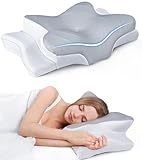
At 4.72 inches of peak loft, the Derila is the tallest contour option here and the most structured. Owner reviews consistently note it holds firm through the night without compressing, which matters for anyone whose airway narrows when the head sinks too low. The memory foam density is high enough that it resists the “bottoming out” problem common in cheaper cervical pillows.
- Pro: Highest structural rigidity in this group, maintaining neck elevation for hours
- Pro: Contour design specifically separates head cradle from neck support, preventing forward flexion
- Con: At $54.99, it is the most expensive option here and the height adjustment is not possible
Skip it if you sleep on your stomach or if you have narrow shoulders, as the 21.25-inch width and firm foam will push your head too high relative to your spine.
Ultra Pain Relief Cooling Pillow for Neck Support
This model is designed for people who overheat at night and whose apnea symptoms worsen with disrupted sleep from temperature discomfort. The cooling layer addresses the thermal component without sacrificing the cervical contour geometry. For back sleepers, the neck support zone is pronounced enough to keep the airway open through the transition from supine to slightly elevated positions.
- Pro: Cooling surface extends usable sleep time by reducing night waking from heat
- Pro: Odorless foam formulation means no off-gassing period before first use
- Con: Cooling layer slightly reduces the perceived firmness of the neck cradle
Pass if you need maximum neck elevation — the cooling foam trades a fraction of support height for thermal performance.
Ultra Pain Relief Cooling Pillow for Neck Support
The same construction makes this a solid entry for side sleepers who need shoulder height accommodation without losing the cervical curve. The adjustable element in this pillow’s design lets you add or remove internal layers, which means you can dial in the exact loft your shoulder width demands. Side sleeping opens the airway naturally for many apnea sufferers, and a pillow that supports proper head-to-spine alignment in that position amplifies the benefit.
- Pro: Adjustable loft makes it viable for both narrow and broad shoulders
- Pro: Ergonomic contour prevents the head from tilting forward during lateral sleep
- Con: Adjustment process requires removing the cover, which is less convenient than zip-access designs
Skip it if you sleep in multiple positions throughout the night, as the loft you set for side sleeping will feel excessive on your back.
Kolbs Bed Wedge Pillow for Sleep Apnea
This is a fundamentally different product category from the others: it is a wedge, not a contour pillow. At 7.5 inches of height, it elevates the entire upper body, which directly addresses the gravitational component of obstructive sleep apnea. Owner feedback highlights that it works well for people who use CPAP machines, as the incline keeps the mask sealed and reduces nasal congestion. It also serves acid reflux sufferers, making it efficient for comorbid conditions.
- Pro: Elevation angle is the single most effective non-device intervention for positional apnea
- Pro: FSA eligible, making it easier to justify as a medical expense
- Con: Takes significant bed space and cannot be paired with a standard contour pillow simultaneously
Skip it if you share a bed with a partner who cannot tolerate a wedge, or if your mattress has a pillow-top that makes the wedge slide.
Ergo Pillow for Sleep Apnea, Neck Pain, and Snoring Relief
The Ergo is positioned explicitly for snoring and apnea rather than generic neck pain, and its contour reflects that priority. The neck cradle is designed to slightly extend the cervical spine, pulling the chin back rather than tucking it forward — a distinction that matters for airway patency. The memory foam has a medium density that provides support without the unyielding firmness that can cause pressure points on the base of the skull.
- Pro: Cervical extension geometry directly targets the mechanism of airway obstruction
- Pro: Medium foam density suits people who find high-density contour pillows uncomfortable
- Con: The gray colorway shows stains and skin oils more readily than darker alternatives
Skip it if you need a pillow that works equally well on your stomach — the contour will be too aggressive.
ZeroZillo Cervical Neck Pillow for Sleep Apnea
At $34.99, the ZeroZillo is the lowest-cost contour option with a design that acknowledges apnea as its primary use case. The neck support ridge is prominent and the head cradle is recessed enough to encourage slight extension. It does not match the build quality of more expensive models, but the fundamental geometry is correct, and owner reviews confirm it provides measurable snoring reduction for mild positional apnea.
- Pro: Correct cervical geometry at the lowest price point in this roundup
- Pro: Snoring relief is the primary design goal, not a secondary claim
- Con: Foam density is lower, meaning it may soften noticeably after several months of nightly use
Skip it if you weigh more than average — lighter foam will not maintain elevation under sustained head weight.
Rioicy Ergonomic Cervical Memory Foam Pillow
The Rioicy is the cheapest entry at $33.29 and has the lowest loft profile in this group, which makes it the only contour option suitable for stomach or semi-prone sleepers. That said, it still maintains a neck support zone that prevents the lateral neck strain those positions normally cause. For people whose apnea is mild and positional (worse on their back, manageable on their side or stomach), this offers alignment support without excessive height.
- Pro: Low profile makes it viable for stomach sleepers who need some cervical support
- Pro: Lowest price point with a dedicated sleep apnea label
- Con: Not suitable for side sleepers — the height is insufficient for shoulder clearance
Skip it if your apnea is moderate to severe, because the elevation benefit will be minimal.
Ultra Pain Relief Cooling Pillow for Neck Support
As a third entry for the stomach-sleeping use case specifically, this cooling model offers the thermal management of its construction at a lower effective loft when the internal layers are reduced to minimum. The odorless foam means no chemical smell disrupting sensitive sleepers who wake easily, and the cooling surface prevents the heat buildup that occurs when a stomach sleeper’s face is pressed into a pillow for extended periods.
- Pro: Cooling and odorless features suit people with heightened sensory sensitivity
- Pro: Adjustable layers allow reduction to a near-flat profile when needed
- Con: At minimum loft, it loses most of the cervical support benefit that makes it relevant for apnea
Skip it if you need meaningful elevation for airway support — in its flattest configuration, it becomes a standard pillow with a cooling cover.
Buying Guide
Contour Height and Shoulder Width
Side sleepers need a pillow that fills the gap between the ear and the mattress without pushing the head past a neutral line. Measure the distance from the side of your neck to the tip of your shoulder. That number, roughly, is the minimum loft you need. The Derila at 4.72 inches suits broad shoulders; the Rioicy at lower profile does not. Back sleepers need less — the goal is a slight extension of the cervical spine, not elevation. The Ergo and ZeroZillo serve this range.
Foam Density and Load Resistance
A pillow that compresses after twenty minutes of use is functionally useless for apnea management. Look for high-density memory foam or polyurethane blends that describe themselves as firm or supportive rather than plush or soft. The Derila and Ergo maintain structure overnight based on owner feedback. The ZeroZillo is the weakest here — its lower density means progressive softening over weeks of nightly use.
Positional Therapy vs. Cervical Alignment
These are different interventions. A wedge like the Kolbs addresses the gravitational component by raising your entire torso, which keeps the tongue and soft palate from falling backward. A contour pillow addresses muscular and skeletal alignment to prevent chin tucking. If your apnea worsens when lying flat, the wedge is the more direct tool. If you wake with neck stiffness alongside apnea symptoms, a contour pillow treats both simultaneously.
Our Verdict
The Ergo Pillow for Sleep Apnea is the best overall pick in this group: correct geometry for cervical extension, appropriate foam density, and a design that explicitly targets the airway mechanism. It is neither the cheapest nor the most expensive, which reflects its balance of features. The budget pick is the ZeroZillo at $34.99, which offers the right shape and purpose at the lowest functional price. If your apnea is combined with acid reflux or you cannot tolerate a contour pillow, the Kolbs Bed Wedge wins on the strength of its elevation angle alone — no contour model in this list replicates what a 7.5-inch incline does for airway patency.
FAQ
Can a pillow actually help with sleep apnea?
A pillow cannot treat moderate to severe obstructive sleep apnea, which requires medical intervention like CPAP therapy. However, for mild positional apnea where symptoms worsen on the back, a contour pillow that prevents chin tucking or a wedge that reduces gravitational airway collapse can decrease symptom frequency and severity.
Is a wedge better than a contour pillow for sleep apnea?
They address different mechanisms. A wedge elevates the upper body to reduce gravitational pressure on the airway. A contour pillow maintains cervical alignment to prevent muscular narrowing. For most people with positional apnea, a wedge has a more direct effect, but a contour pillow is better if neck pain accompanies the condition.
How often should I replace a memory foam pillow used for apnea support?
Owner reports suggest that lower-density foam contour pillows lose structural integrity within six to twelve months of nightly use. Higher-density options like the Derila last longer, but once the neck cradle compresses enough that the head touches the base of the pillow, it is no longer providing meaningful support and should be replaced.
Can I use a sleep apnea pillow with a CPAP machine?
Yes, and some combinations are particularly effective. A wedge provides the elevation benefit without interfering with mask straps, while contour pillows work with nasal pillows or minimal-contact mask designs. Avoid bulky cervical pillows that push the chin upward against the mask seal, as this can compromise pressure delivery.