Key takeaways
- Plan for at least 12 inches of clearance from combustible walls unless the manufacturer and local code require more.
- Leave approximately 24–36 inches of working space in front of the kiln so you can load it without twisting or reaching across hot surfaces.
- Keep shelving, curtains, paper, wood furniture, and storage bins outside the manufacturer’s specified clearance zone.
- In a 10-by-12-foot room, a compact kiln, metal stand, worktable, and ventilation route can fit comfortably; a large kiln may consume one entire wall and restrict safe access.
- Measure doorways, stair turns, and elevator openings before ordering. A kiln cabinet may fit through a 30-inch doorway but be difficult to turn in a narrow hall.
The best glass fusing kilns for a home studio are usually compact top-loading models with a chamber at least 8–12 inches deep, a maximum temperature of about 1,700–2,000°F, a programmable digital controller, and a dedicated 120V or 240V circuit selected to match your available power.
Choosing by brand alone can lead to an awkward installation, insufficient shelf space, or an electrical upgrade you did not budget for. The practical decision is to match the kiln’s chamber size, heating performance, controller, power draw, ventilation plan, and moving requirements to the room where you will use it.
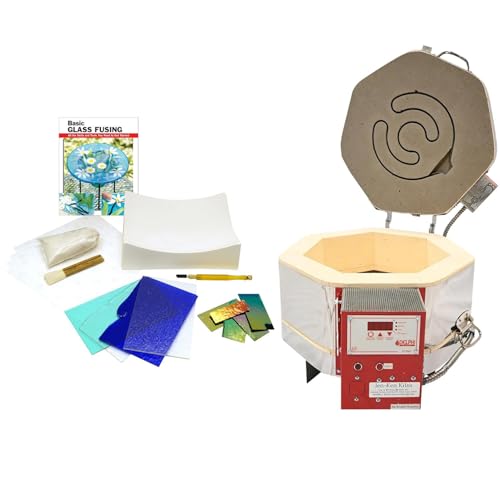
Delphi Glass Studio in A Box Kit | Glass Fusing Kiln, 90 Coe Glass, Supplies
Included for 'Best Glass Fusing Kilns: Size, Temp & Safety Guide' because the listing specifies Glass Fusing Kiln and 90 Coe Glass, details this guide uses to compare options.
View on Amazon
Paragon SC2 Programmable Digital Kiln 1680W 120V 14A with Sentinel Touch Xpress
Included for 'Best Glass Fusing Kilns: Size, Temp & Safety Guide' as a relevant option in this category; details come from the product listing.
View on Amazon
RapidFire Pro-L Portable Digital Kiln Furnace with RapidHeat – 2200°F Electric Jewelry Making, Metal Clay, Enameling, Glass Fusing, Test Firing – Made in USA
Included for 'Best Glass Fusing Kilns: Size, Temp & Safety Guide' because the listing specifies 2200°F Electric Jewelry Making and Metal Clay, details this guide uses to compare options.
View on Amazon
WICAND Microwave Kiln Fusing Glass for Making DIY Jewelry Tools 15pcs Set
Included for 'Best Glass Fusing Kilns: Size, Temp & Safety Guide' as a relevant option in this category; details come from the product listing.
View on AmazonBest glass fusing kilns by home-studio situation
| Studio situation | Most suitable kiln type | Useful chamber size | Typical power requirement | Why it fits |
|---|---|---|---|---|
| Apartment or small craft room | Compact top-loading glass kiln | 8–12 in. wide, 8–12 in. deep | 120V, approximately 15–20A | Fits small work and is less demanding to install |
| Dedicated home studio | Medium square or round kiln | 14–18 in. wide, 6–12 in. deep | 120V or 240V, approximately 20–30A | Handles plates, tiles, and several small pieces |
| Large panels or regular production | Large top-loading or front-loading kiln | 18–24+ in. wide, 12–18+ in. deep | 240V, often 30–50A | Provides more working area but needs more space and infrastructure |
| Occasional jewelry and small ornaments | Small programmable kiln | 6–8 in. wide, 6–8 in. deep | 120V, commonly 15A | Lower purchase and operating demands |
Chamber size: measure the firing area, not the outside cabinet
Manufacturers usually state interior chamber dimensions, but the kiln’s external footprint may be several inches larger on every side. A kiln advertised as 12 inches wide may require a stand and a safe installation zone measuring closer to 24–30 inches wide.
For small fused-glass jewelry, coasters, pendants, and ornaments, an interior shelf around 6–8 inches square may be adequate. An 8–12-inch chamber is more versatile for small plates, tiles, and multiple pieces. Choose a 14–18-inch chamber when you want to fuse larger plates or work on several items at once.
Depth matters as much as width. A kiln with a 16-inch diameter may sound spacious, but a shallow chamber may not accommodate a tall slumped vessel. For slumping, check the interior height and the height of the mold—not just the shelf diameter.
Room-fit measurements that are easy to overlook
- Plan for at least 12 inches of clearance from combustible walls unless the manufacturer and local code require more.
- Leave approximately 24–36 inches of working space in front of the kiln so you can load it without twisting or reaching across hot surfaces.
- Keep shelving, curtains, paper, wood furniture, and storage bins outside the manufacturer’s specified clearance zone.
- In a 10-by-12-foot room, a compact kiln, metal stand, worktable, and ventilation route can fit comfortably; a large kiln may consume one entire wall and restrict safe access.
- Measure doorways, stair turns, and elevator openings before ordering. A kiln cabinet may fit through a 30-inch doorway but be difficult to turn in a narrow hall.
Maximum temperature: important, but not the only performance measure
Most glass fusing work takes place below the maximum temperature printed in the specifications. Full-fuse schedules often reach roughly 1,450–1,500°F, while tack fusing uses lower temperatures and slumping commonly falls in the approximate 1,100–1,300°F range. A kiln rated near 1,700–2,000°F therefore provides useful headroom, but maximum temperature alone does not prove that it is the best kiln for glass.
Look for even heating, a well-insulated chamber, reliable thermocouple placement, and a controller that can hold a temperature for the required soak. A kiln with a lower advertised maximum temperature may produce more consistent glass results than a hotter kiln with poor temperature control.
What the controller should do
- Basic digital controller: Suitable for simple ramp-and-hold programs and occasional fusing. It is usually less expensive but may offer fewer editable steps.
- Multi-step programmable controller: The best general choice for home glasswork. It can control ramps, holds, annealing, and controlled cooling in one program.
- Advanced touchscreen or Wi-Fi controller: Convenient for saving schedules and monitoring progress, but connectivity does not replace proper supervision or a suitable firing schedule.
- Manual switch control: Better suited to simple craft firing than repeatable fusing. It requires more attention and makes controlled annealing harder.
Annealing is particularly important. The controller needs enough steps and hold time to cool the glass through its annealing range gradually. The correct schedule depends on the glass type, thickness, size, and compatibility, so do not copy a program without checking the glass manufacturer’s guidance.
Power needs: choose the circuit before choosing the kiln
Compact kilns often operate on a standard 120V circuit, but many draw close to the circuit’s practical limit. Larger units commonly use 240V and require a dedicated breaker. Electrical requirements vary by model, so use the manufacturer’s nameplate data rather than estimating from chamber size.
| Electrical setup | Typical home-kiln use | Planning notes |
|---|---|---|
| 120V, 15A | Small jewelry and ornament kilns | Avoid sharing the circuit with heaters, microwaves, or other high-load appliances |
| 120V, 20A | Compact to medium glass kilns | May require a dedicated receptacle and circuit |
| 240V, 20–30A | Medium kilns and faster heating | Have an electrician confirm breaker, wiring, receptacle, and local code |
| 240V, 40–50A | Large production-oriented kilns | Often unsuitable for a casual room without electrical upgrades |
Do not use an extension cord or power strip unless the kiln manufacturer specifically approves the arrangement. A dedicated circuit reduces nuisance trips and overheating risk. An electrician can also confirm whether your panel has capacity and whether the kiln’s plug matches the installed receptacle.
Ventilation and indoor safety
Glass firing can release fumes from binders, shelf primers, glass coatings, and contaminants. A kiln should not be treated like an ordinary countertop appliance. Install it in a clean, dry, well-ventilated area, follow the manufacturer’s ventilation instructions, and check local building and fire requirements.
A kiln vent system can remove air from beneath or around the chamber and discharge it outdoors. A window fan alone may not capture emissions effectively, and it can create drafts that affect temperature stability. Avoid placing the kiln in a bedroom, enclosed closet, or room used for food preparation.
- Keep a suitable fire extinguisher accessible, but not directly beside a hot kiln where it could be blocked.
- Use heat-resistant shelves and a manufacturer-approved stand.
- Never place combustibles beneath or against the kiln.
- Inspect the lid, elements, thermocouple, wiring, and controller periodically.
- Do not leave children or pets able to approach the hot surface or open lid.
- Follow the kiln manual for loading, lid position, cooldown, and unloading.
Established brands and what to compare
Established kiln manufacturers such as Skutt, Paragon, Evenheat, and Olympic Kilns offer models intended for glass, ceramics, or both. Availability, controller options, element layout, warranty coverage, and electrical specifications vary by model. Compare the actual data sheet rather than assuming every kiln from a brand has the same capabilities.
For a first home studio, a compact glass-specific model from one of these manufacturers is often easier to program than a large ceramic kiln. Ceramic kilns can be useful when you also fire clay, but their taller chambers and higher power requirements may provide little benefit for flat fused-glass work.
Moving, installation, and durability realities
Small kilns can still be surprisingly heavy because of their steel shell, insulation, lid, elements, and controller. A compact unit may weigh roughly 50–100 pounds, while medium and large models can exceed 150 pounds. Arrange two-person lifting or a rated dolly, and remove movable shelves before transport.
Use a rigid, level, noncombustible stand that can support the kiln’s full weight. Wheeled furniture is not automatically suitable: casters must lock, the frame must resist tipping, and the stand must tolerate heat. Never place a kiln on a wooden craft table unless the manufacturer explicitly permits it and the required heat shielding is installed.
Heating elements and thermocouples are commonly among the first service items to wear, especially with frequent high-temperature firing. Ask whether replacement parts are available, whether the controller can be serviced, and whether the manufacturer publishes element and thermocouple replacement instructions.
A practical buying decision
Choose a small 120V kiln if your work is mostly jewelry, small tiles, and occasional projects and you have limited space. Choose a medium programmable kiln if you want one versatile appliance for plates, slumping molds, and regular fusing. Choose a large 240V model only when your projects justify the capacity and an electrician has confirmed the installation.
Before ordering the best glass fusing kiln for your home, write down the largest piece you will fire, measure the proposed room and doorway, confirm the circuit, identify the ventilation route, and calculate the stand’s weight capacity. Those checks usually matter more than a slightly higher maximum-temperature rating or a longer feature list.