
Key takeaways
- An ergonomic workspace is a place where the chair, work surface, screen, input devices, and daily routine fit the person doing the work. That is the useful answer to what is an ergonomic workspace: an arrangement that reduces unnecessary reaching,…
An ergonomic workspace is a place where the chair, work surface, screen, input devices, and daily routine fit the person doing the work. That is the useful answer to what is an ergonomic workspace: an arrangement that reduces unnecessary reaching, awkward viewing, and fixed postures without requiring premium furniture.
As an Amazon Associate we earn from qualifying purchases.
By KK Home Furnishings Editorial Team
Core Elements of an Ergonomic Workspace
Think of the workstation as a connected system. A comfortable chair cannot compensate for a screen positioned far to one side, while an adjustable desk can still force raised shoulders if the keyboard is too high. OSHA’s Computer Workstations eTool emphasizes fitting the entire arrangement to the worker, not identifying one ideal posture for everyone.
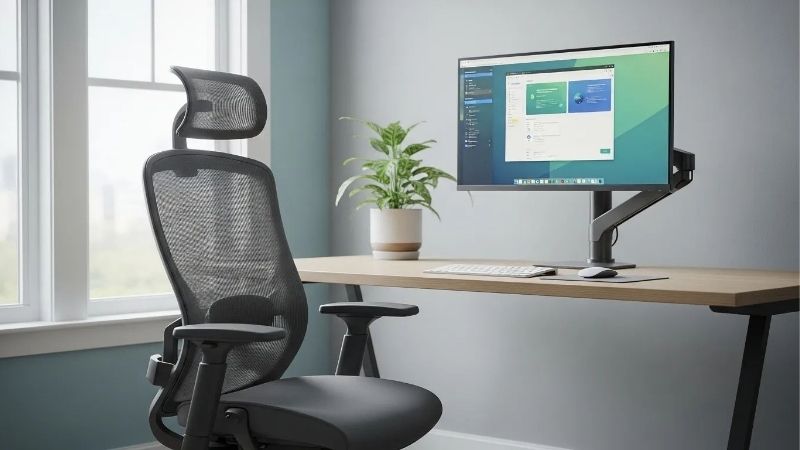
| Workspace element | What to check | Useful first adjustment | When an accessory may help |
|---|---|---|---|
| Chair and feet | Back supported; feet stable; room to change position | Match seat height to keyboard and leg support | A footrest when the chair must be raised |
| Desk and clearance | Working height and free space for knees and feet | Remove storage from the leg area | A suitable keyboard tray if desk height cannot change |
| Monitor | Readable distance, forward viewing, manageable reflections | Place primary screen directly ahead | A stable riser or adjustable monitor arm |
| Keyboard and mouse | Elbows near the body; wrists reasonably straight | Bring both devices into easy reach | External input devices for a raised laptop |
| Lighting | Readable documents without harsh screen reflections | Reorient screen relative to windows and lamps | Adjustable task light for paper-based work |
| Work routine | Opportunities to move or change tasks | Build short position changes into the day | None required to begin |
Fit the Equipment to the Task and the User
Ergonomics starts with what people do, how often they do it, and which tools they must reach. A writer may spend most of the day typing, while a designer needs space to compare visuals and a customer-support agent regularly changes between calls and software. The same desk layout will not fit these activities equally well, even if the furniture is identical.
Consider the relationships before shopping. If the work surface is too high for relaxed keyboard use, adjusting the chair may leave the feet unsupported; a footrest can resolve that secondary problem. If the monitor is too low, raising just the display may be more practical than replacing a desk. Start with the constraint you can observe rather than a product claim.
Keep Sightlines, Reach, and Support in Balance
The main screen should generally sit directly ahead so regular reading does not require turning the neck. Mayo Clinic’s May 2023 office-ergonomics guidance describes roughly an arm’s-length viewing distance, with 20 to 40 inches as a reference range. Text size, screen dimensions, vision needs, and prescription lenses can change what is comfortable in practice.
The keyboard and mouse should stay close enough that the upper arms do not continually stretch forward. Keep the desk edge from pressing firmly into the wrists or forearms, and avoid using piles of equipment under the desk that block leg movement. An ergonomic workspace is not one frozen position: the point is to make ordinary tasks easier without repeated awkward reaches.
Make Space for Movement and a Manageable Environment
Lighting, glare, walkways, temperature preferences, and noise can influence whether a good-looking workstation remains usable. Reflections that force someone to crane forward may matter more than the brand of the chair. Position lamps so paper is readable while the monitor remains free from distracting glare, and route cables away from feet and walking paths.
CDC/NIOSH office-environment guidance updated in July 2026 highlights the value of reducing overreaching, awkward positions, and prolonged static work. It also notes evidence that short breaks each hour can reduce computer-work discomfort. Such guidance is a reason to build flexibility into the working day, not proof that a particular desk or chair prevents injury.
Adjust for Your Situation
There is no universal shopping list for a comfortable workspace. The useful question is which repeated action makes you move out of a relaxed position: looking down, stretching for a mouse, squeezing your knees under storage, or changing between devices. The situations below show how to correct a mismatch without turning a definition into a long product roundup.
A Laptop Used at a Kitchen Table
A laptop combines the display and keyboard in one fixed relationship. Raising the screen to a more convenient viewing height can make the built-in keyboard uncomfortable to reach; lowering it for typing can put the screen far below the desired sightline. This trade-off is about the geometry of the device, not necessarily an inadequate chair.
For substantial laptop work at a fixed station, Mayo Clinic suggests an external keyboard and mouse with a laptop stand. Position the display where text is readable without jutting forward, then place the external inputs at a usable height. For a brief session, temporary adjustments and more frequent changes of position may be more realistic than a permanent equipment purchase.
A Single-Monitor Desk for Daily Typing
With one main monitor, the critical relationship is between the line of sight and the keyboard’s working position. Place the screen approximately in front of the input area, keep frequently used materials near your hands, and check that the chair can pull close to the work surface without the armrests colliding with it.
Evaluate the ordinary task, not a staged photograph. A deep desktop is useful only if the screen can be read comfortably and the mouse is still close. If a fixed desk makes the forearms angle upward, first explore a suitable chair adjustment and supported feet, or a properly mounted input tray. More desk surface alone does not solve the height mismatch.
Two Screens for Analysis or Editing
Dual monitors add a direction problem that single-screen advice can overlook. OSHA’s workstation purchasing guidance recommends positioning the monitor used most directly in front of the worker, with the other nearby. If attention is divided evenly, side-by-side placement with a manageable viewing angle can reduce repeated extreme head turns.
Before purchasing monitor arms, check the usable desk depth, the monitor stands, and whether the displays obscure natural light or create reflections. A large extra screen can improve visibility for comparing documents but also increase neck movement if placed too far away. The preferred layout depends on where the primary task occurs, not the number of displays alone.
A Shared Workstation With Different Users
In a shared room, furniture that fits one person may be awkward for the next. Quick, accessible adjustments matter more than a long list of rarely used features. A screen riser with several secure positions, a chair with a genuinely usable height range, and devices that can be repositioned may serve this setting better than fixed solutions.
The useful habit is a brief check at the start of a shift: can the person see the main display directly, work without raised shoulders, and rest the feet securely? That is different from a company-wide office-design strategy. At the level of one workstation, the goal is simply to make the necessary controls reachable and to avoid requiring everyone to use identical settings.
A Small Home Office With Limited Floor Space
In an apartment corner, tight clearances create practical ergonomic constraints. Shelves may restrict screen placement, desk legs may block the chair, and a storage box beneath the top may consume the very space needed for feet. Measure the usable work zone before replacing the chair, and consider where the chair moves when someone stands up.
Freeing a few inches of unobstructed floor or desk depth may deliver a more noticeable day-to-day improvement than an expensive accessory. A compact monitor arm could help when the desk supports its clamp and load, but an unstable folding table should not carry an arm without verified compatibility. Choose a safe layout first, and add equipment only to solve a defined problem.
A Desk Used for Both Sitting and Standing
A height-changing desk offers a way to vary posture, but the seated and standing positions must both fit the task. At either height, check that the keyboard does not require lifted shoulders and that the monitor remains easy to read. Moving the desktop without moving the display and inputs into a workable relationship simply transfers the mismatch.
CDC/NIOSH advises avoiding prolonged sitting or standing rather than treating either position as the one correct answer. During changes, watch that cords can move freely and that nearby objects will not catch on the work surface. This article explains what makes the overall area ergonomic; precise standing-desk heights and programming steps belong in a separate setup guide.
Frequently Asked Questions
The practical questions usually involve individual fit, equipment constraints, and the limits of common ergonomic rules. The answers below describe useful exceptions without turning one suggested arrangement into a universal prescription.
Should the Monitor Be Lower if You Wear Bifocals?
Often, yes. Mayo Clinic notes that people who wear bifocals may find it more comfortable to position the display an additional 1 to 2 inches below a general monitor-height reference. The reason is practical: looking through a lower portion of the lens should not require tilting the chin upward for long stretches.
Progressive lenses and individual prescriptions can introduce different viewing needs, so treat the measurement as a starting point, not an optical prescription. If text remains hard to see at a comfortable head position, consider display scaling and advice from an eye-care professional rather than repeatedly forcing the neck into a fixed angle.
Can a Left-Handed Person Use the Same Desk Arrangement?
Yes, but the placement of frequently used tools may differ. A left-handed mouse user may prefer the pointer on the left with enough surface area to move freely. The principle is unchanged: the device should be close enough that the forearm does not have to travel across the desk for every small action.
Some people write with one hand and use their mouse with the other, so copying a generic left-handed photograph is not a reliable solution. Put the most frequent controls near the hand that actually operates them, then confirm the keyboard remains reasonably centered to the main screen. Task demands matter more than the person’s label.
Is a Footrest Required for Every Desk?
No. If the user’s feet rest comfortably on the floor while the keyboard and chair are at workable heights, adding a footrest may not solve anything. It becomes useful when raising the chair to meet a nonadjustable work surface would otherwise leave the feet hanging or unsupported.
Look for a stable, appropriately sized platform rather than assuming a particular angle or height works for all users. A temporary sturdy support may help demonstrate whether the adjustment is worthwhile. A dedicated accessory is most useful when the need is consistent and it remains steady under the feet during ordinary use.
Do You Need to Buy Expensive Furniture to Be Ergonomic?
No. A better arrangement can begin with reducing clutter, shifting the screen, bringing the mouse closer, and changing how work is scheduled. OSHA describes its computer-workstation guidance as covering simple, often inexpensive principles. Higher-priced equipment is not automatically a better fit for an individual user.
Spend only after identifying a constraint that rearrangement cannot solve. A monitor arm may be worthwhile when the screen cannot reach an appropriate position; a different desk might be warranted when the work surface never fits the user’s keyboard height. Even a premium chair cannot replace thoughtful equipment placement and movement.
Final Thoughts
What is an ergonomic workspace in practice? It is a place where daily tasks allow comfortable sightlines, reachable controls, supported feet, and changes of position. Evaluate those relationships while actually working, correct the largest mismatch first, and treat new furniture as a targeted tool rather than a cure-all.









