
Key takeaways
- Usually, no: a decorative console table should not be treated as a television stand simply because the screen fits or the table has a published load rating. Can a console table be used as a tv stand? Only when its…
Usually, no: a decorative console table should not be treated as a television stand simply because the screen fits or the table has a published load rating. Can a console table be used as a tv stand? Only when its manufacturer expressly permits that use, the actual TV base and weight meet the furniture instructions, and both pieces can be secured appropriately. Otherwise, use a purpose-built TV bench or mount the television independently and keep the console beneath it for storage.
As an Amazon Associate we earn from qualifying purchases.
By KK Home Furnishings Editorial Team
When Is a Console Table Suitable for a Television?
A console table is normally chosen for a hallway, entryway, or the space behind a sofa, whereas a TV stand is designed around a television’s base, supported weight, stability, and viewing position. Similar-looking tabletops do not make the two interchangeable. Before moving the screen, separate three questions that people often combine: intended use, physical footprint, and the room’s ability to resist a tip-over.
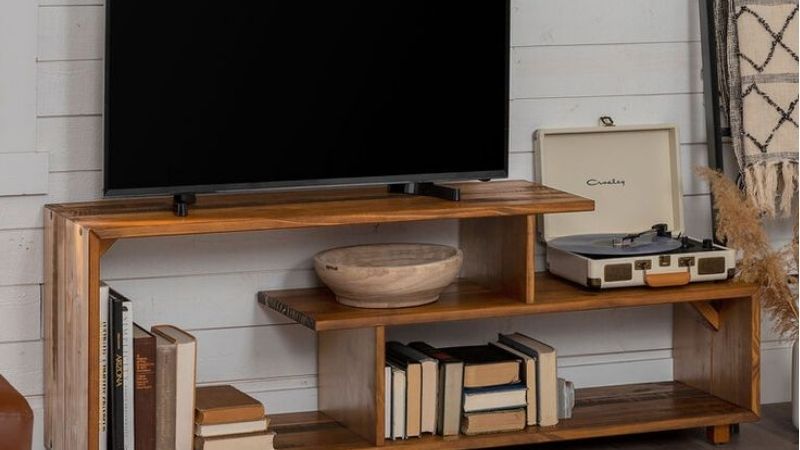
Confirm TV Use Instead of Trusting the Top Load Alone
Start with the precise model number and its assembly or care document. A manufacturer may disclose a tabletop capacity for decorative objects while never approving a television, whose raised mass and relatively narrow feet introduce different stability concerns. The US Consumer Product Safety Commission advises placing TVs only on furniture designed to hold them, such as TV stands and media centers [CPSC, Anchor It!, accessed October 2026]. If the manufacturer has not approved a console table for that purpose, its load figure is not permission to improvise.
For a concrete comparison, IKEA lists a 44-pound maximum tabletop load for its LACK console table, about 55 1/8 inches wide and 15 3/8 inches deep [IKEA US, accessed October 2026]. Those numbers describe that console model’s top and dimensions; IKEA does not present this listing as a TV bench. A dedicated IKEA BESTÅ TV unit, 47 1/4 inches wide and 15 3/4 inches deep, is explicitly described as a TV unit with a maximum TV weight of 35 pounds and a wall-anchoring requirement [IKEA US, accessed October 2026]. Comparing 44 with 35 without the different intended uses would be misleading.
Match the Actual TV Feet, Depth, and Stability
Television diagonal is the distance across the screen, not the footprint of the legs or center pedestal. Some screens have widely spaced feet; others can be configured in different positions. Sony’s US support instructions describe particular BRAVIA series with inside, outside, or raised tabletop stand positions, but warn that the instructions depend on the model [Sony US, 2026]. Check the precise setup guide for your television and measure the feet in their intended installed position.
Both feet or the full pedestal must rest entirely on a flat, structurally supported section of furniture. Overhanging legs, a bowing top, a loose joint, or an unstable narrow base are reasons to stop, not problems to hide with a mat. A heavy television at the back of a long table can still be unstable if the unit rocks or its frame is not designed for that load distribution. Do not alter the TV’s factory stand or improvise a top extension to force a fit.
Check Anchoring, Height, and How the Room Is Used
The safety question is not solved merely by locating a stud. CPSC warns that unsecured furniture and televisions can tip, and its published advice calls for anchoring TVs and furniture while keeping screens on sturdy, low bases [CPSC, 2023]. A console table can be taller and slimmer than a low media unit, putting the display higher above seated eye level. That affects viewing comfort and also leaves less margin when someone bumps or pulls the furniture.
Choose a wall anchor or TV restraint only when the specific products and mounting surface are compatible and their instructions permit that configuration. A thin backing panel is not automatically an approved anchor point. If the table sits in a busy hall, behind a sofa, or anywhere children or pets can tug on cords, a purpose-built lower stand or independently secured wall-mounted TV is the safer default. Do not confuse an anti-tip strap with permission to exceed an unapproved furniture use.
| Decision point | Use the console only if | Stop or choose another setup when | How to verify |
|---|---|---|---|
| Manufacturer approval | Exact model permits TV placement | Only a generic decor weight limit is stated | Model manual or written manufacturer reply |
| TV load | TV and supported accessories meet the stated limit | TV use or allowable load is unspecified | Exact TV mass and furniture instructions |
| Base footprint | Both legs or full pedestal fit completely | Feet overhang or sit on unsupported edges | Physical TV stand-width and depth measurements |
| Stability | Level surface, compatible anchoring and restraints | Rocking frame, loose joints or unapproved anchoring | Inspect and follow both product manuals |
| Viewing layout | Seated sightline and traffic paths remain workable | Screen is too high or in an impact-prone passage | Measure from the normal viewing seat |
| Alternative arrangement | Wall-mounted TV is structurally independent | Console is still being asked to support the screen | Confirm wall bracket and mounting approval |
Adjust for Your Situation
The scenarios below distinguish when a console table is part of a workable TV wall from when it is a poor substitute for actual media furniture. Each conclusion depends on the manufacturer’s stated use and your room, not on an invented minimum screen size, a universal load number, or a decorative style label.
A Console Table Specifically Approved to Support a TV
A hybrid piece marketed and documented for television support may be suitable even if a retailer uses the word console in its name. Product names are less important than the assembly guide, approved weight, TV footprint requirements, and securing instructions. If those checks agree with your specific screen, the table can serve as the display platform. Keep any center pedestal within the solid supported top and check that the furniture remains level after assembly.
Do not assume that an approved top eliminates the need to secure a screen. CPSC’s Anchor It! guidance calls for securing televisions even when they are standing on furniture [CPSC, Anchor It!, accessed October 2026]. Follow the actual TV and furniture anchoring instructions rather than attaching an arbitrary strap to an ornamental rail. The approval for one model or size does not extend to the rest of a brand’s console tables.
A Decorative Entryway Console With a High Load Rating
This is the common trap. A retailer listing may look encouraging because the tabletop has a published weight capacity, yet the piece was meant for lamps, frames, or baskets rather than a tall electronic display. IKEA’s LISTERBY console table, for example, is about 36 1/4 inches wide, 15 inches deep, and 28 inches tall, with a 44-pound top limit [IKEA US, accessed October 2026]. That describes this particular console; it is not a manufacturer TV-use approval.
Do not transfer the LISTERBY load figure to other wooden console tables, and do not treat a heavier top rating as stronger evidence of television suitability than a purpose-built stand’s explicit instructions. If the model has no documented TV designation, use the table for decor and choose a rated TV stand. An attractive finish, solid-feeling legs, or multiple positive furniture reviews cannot substitute for the missing approval.
A Narrow Table Behind a Sofa or in a Hallway
A sofa table often sits where people lean, brush past, drop bags, or reach around a seat. That traffic matters more than whether its top is visually long enough to center a television. The table may also be too tall for comfortable viewing from a nearby couch. If cords run down the back, an accidental pull could disturb equipment or create a tripping hazard. A long, shallow profile is not a meaningful stability guarantee.
Keep a behind-the-sofa or hallway console in its original furniture role. If you need a screen in that area, evaluate an appropriately supported wall mount and choose a viewing angle that does not interfere with circulation. A purpose-built low TV unit elsewhere in the room is generally easier to inspect and secure than a narrow decorative table in a high-contact passage.
A TV With Wide Legs or a Large Center Pedestal
Foot placement can disqualify a table even when the television looks visually narrower than the tabletop. Two legs set toward the outside edges need continuous support under both mounting points. A center pedestal may fit a short top but concentrate weight over one section. In either case, use the stand-width and depth dimensions in the exact TV manual, not a guess derived from screen size.
Some Sony televisions have manufacturer-approved stand-position changes, but Sony instructs owners to use the model-specific setup guide and suitable assistance when changing a stand [Sony US, 2026]. Do not reverse or modify legs because the console is a little too narrow. If you cannot obtain a documented match for both TV and furniture, use a correctly rated media stand or the television maker’s approved mounting solution.
A Wall-Mounted Television With a Console Beneath It
This layout often meets the decorative goal without asking an entryway table to carry a TV. A properly wall-mounted television transfers its load to an approved bracket and suitable wall structure, while the console below holds only items within its intended weight rating. You can keep the same narrow profile, add baskets or a soundbar if those items are allowed, and leave the top visually uncluttered.
Make sure the wall mount is appropriate for the screen and building material, and follow its installation instructions. Sony recommends qualified installation for its compatible TV wall-mount procedure and warns against unsuitable fixing hardware [Sony US, 2024]. The console is not a structural backup for the screen; the TV must be secure even if the table is moved away. Check cable paths so the cords do not invite pulling or snagging.
A Family Room With Children, Pets, or Frequent Rearranging
An unapproved TV-on-console arrangement is particularly poor in a room where people may pull at a drawer, climb onto a shelf, or bump the back of the furniture. CPSC’s 2023 report documents continuing tip-over injuries and recommends anchoring TVs and furniture, low stable placement, and removing tempting objects from upper surfaces [CPSC, 2023]. The hazard is the entire arrangement, not simply the stated weight of the television.
Choose a purpose-built media stand with the correct TV approval, or mount the screen separately using a compatible system. Secure all applicable furniture as directed and keep heavy objects low. If you frequently rearrange the room, plan the approved anchoring positions before moving the setup rather than leaving a loose television in place temporarily. A less fashionable but correctly supported TV wall is a better outcome than a fragile workaround.
Frequently Asked Questions
These related questions address accessories and modifications that buyers often consider after discovering that a favorite console table was not designed as a TV stand. They do not turn an unapproved table into rated TV furniture.
Can a universal TV pedestal make a console table safe?
Not automatically. A replacement pedestal may reduce the footprint of a television that originally used wide legs, but it can also concentrate the television’s weight in one smaller area. Both the pedestal and the supporting furniture must permit the resulting configuration. A pedestal’s published TV size or VESA compatibility cannot establish that a decorative table is stable enough.
Use an aftermarket TV pedestal only if it is compatible with the television and can be installed as its manufacturer directs. If the console itself is not intended for television support, changing the pedestal does not resolve that original problem. An independently mounted television or designated TV stand remains the clearer choice.
Is a glass-top console table suitable for a TV?
Only if the exact glass-top furniture model expressly permits TV placement and its instructions cover the intended equipment. Decorative tempered glass is not by itself a statement about allowable concentrated TV loads, edge support, anchoring points, or stability. Do not assume that one glass-top console shares the rating of another just because the panels look similar.
If manufacturer documentation is missing, avoid the experiment. Heavy electronics and fragile surfaces make guesses costly. A dedicated TV stand with published TV support and installation requirements is easier to evaluate than a decorative glass table of unknown intended use.
Can you reinforce a console table to hold a heavier television?
Adding screws, brackets, or a plywood panel can change how the table carries a load, but it does not retroactively create manufacturer approval for a television. The weak point may be the legs, joints, fasteners, or resistance to forward tipping rather than the top panel. Even a neat-looking reinforcement can move the problem elsewhere.
Do not exceed the furniture maker’s limits or follow improvised online reinforcement plans as a safety certification. If you are considering custom furniture for a TV, ask a qualified fabricator to design the entire support and securing system for that particular television rather than relying on a generic tabletop repair.
Can a soundbar or game console go on a console table under a mounted TV?
Possibly. Once the television is independently wall-mounted, a console table may be used for accessories within its published top or shelf limits and the manufacturer’s intended use. Check the equipment’s ventilation requirements, the table’s level surface, and how cables enter the room. Leave openings unobstructed and avoid balancing a soundbar across unsupported edges.
This is different from using the table to support the television itself. A small accessory can still be unsuitable if it blocks airflow, creates a tripping cord, or exceeds a glass shelf’s permitted load. Keeping equipment within its own published requirements preserves the visual benefit of the console without inventing a TV-load approval.
Final Thoughts
So, can a console table be used as a tv stand? Generally not unless that exact console is explicitly approved for supporting a television and the TV’s weight, stand footprint, and required securing method all meet the manufacturers’ instructions. A generic tabletop weight rating is not enough: IKEA’s LACK and LISTERBY console specifications are examples of decor-table limits, whereas the BESTÅ TV unit publishes a distinct television rating [IKEA US, accessed October 2026]. The most flexible compromise is to mount the TV independently and use the console below for appropriate accessories. When the screen must rest on furniture, follow CPSC advice and choose sturdy, low furniture designed for TVs, with compatible anchoring [CPSC, 2023].
