Key takeaways
- A split mattress gap filler bridges the valley between two mattresses, but the right one depends on your actual gap width and how well it keeps the mattresses from drifting apart. This guide compares four current bed bridges on gap…
A split mattress gap filler bridges the valley between two mattresses, but the right one depends on your actual gap width and how well it keeps the mattresses from drifting apart. This guide compares four current bed bridges on gap capacity, insert design, and strap systems.
As an Amazon Associate we earn from qualifying purchases.
By KK Home Furnishings Editorial Team
How to Choose a Split Mattress Gap Filler
The right filler is sized to your gap and your bed, so these criteria stay practical: measuring the actual gap first, weighing bridge width against center insert depth, checking strap systems that reduce mattress drift, and confirming the length matches a Twin or Twin XL rather than guessing at the size.
Measure the Actual Gap First
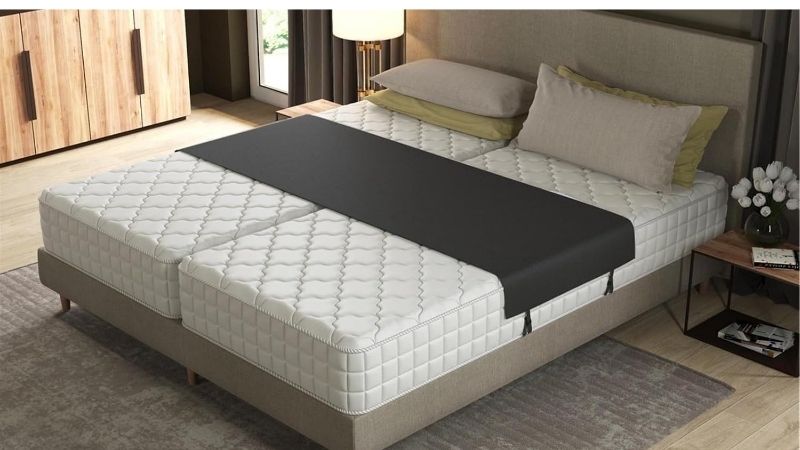
The gap is the first measurement, and products vary widely in how wide a space they bridge. The MildMate lists a maximum gap of about 2.5 centimeters, roughly 1 inch, while the EPHEDORA claims up to 5 inches, so measure your real gap with both mattresses in their normal, slept-on position before choosing any filler.
Measure the gap under normal use, not when the mattresses are pushed tightly together, since they drift apart during sleep. A filler rated for a small gap cannot fill a wide one, so match the maximum supported gap to your measurement, because a bridge too small leaves a ridge and one too large can bunch up in the middle.
The common mistake is buying before measuring, since listings describe very different gap ranges from one to five inches. A 1-inch-rated filler and a 5-inch-rated one are not interchangeable, so confirm the maximum gap for the exact model, and remember a filler reduces the valley but cannot fix mattresses separating from a larger cause.
Bridge Width vs Center Insert Depth
Fillers come as wide bridges laid across both mattresses or as wedge inserts dropped into the gap itself. The EPHEDORA lists a 12-inch top width over an 80-inch length, spreading across both mattresses, while a T-shaped design like the MildMate seats into the gap, so the shape changes how the filler sits and feels under a sheet.
A wide bridge smooths a broad area and resists sinking, suiting a noticeable gap, while a narrow insert fills a thin seam. Match the design to your gap size and feel preference, since a wide bridge can be felt as a firmer band across the bed, whereas an insert is more localized but can shift if the gap widens during the night.
Depth matters too, since an insert must reach deep enough to support weight without bottoming out in the gap. A foam bridge like the VEVOR’s 25-density memory foam holds its shape under pressure, so check the material and depth, because a thin or soft insert compresses and reopens the valley exactly where two sleepers meet in the middle.
Strap Systems Reduce Mattress Drift
A filler only stays effective if the mattresses do not drift apart, which is where strap systems come into play. The EPHEDORA and GIVIMO list straps around 33 feet long that wrap the mattresses together, so a strap system does the second job of a gap filler, holding the two mattresses in place rather than only covering the seam.
Straps matter most on beds where mattresses slide, since a bridge alone rides up if the gap keeps opening during sleep. A long wrap-around strap cinches both mattresses as a unit, so look for one if your mattresses separate, because the best insert still fails if the underlying mattresses drift apart and reopen the gap beneath it.
Strap length and routing decide whether the system fits your bed, since a short strap cannot wrap a tall or deep mattress set. Confirm the strap reaches around your mattresses and base, and check how it anchors, since a strap that loosens over time lets the mattresses drift again, undoing the filler’s job within a few weeks of use.
Twin vs Twin XL Length Matters
Split beds use Twin or Twin XL mattresses, and the filler length must match, since the two sizes differ in length. A Split King uses two Twin XL mattresses at 80 inches long, so an 80-inch bridge like the EPHEDORA fits, while a Twin version runs about 75 inches, so confirm the length before assuming any bridge fits your bed.
Match the filler length to the mattress length so it spans the full seam without hanging off or falling short. An 80-inch bridge on a 75-inch Twin leaves an overhang, while a 75-inch filler on an 80-inch Twin XL leaves a gap at the foot, so confirm whether your split bed uses Twin or Twin XL mattresses before you order a filler.
Width of the top panel also affects coverage, since a 12-inch-wide bridge spreads across the seam more than a narrow insert. Check both the length and the top width against your bed, since a filler that is the right length but too narrow still leaves a ridge, and one too short exposes part of the gap at the head or the foot.
Top Picks
These four are current bed bridges compared on maximum gap, insert design, and strap systems rather than price alone; all sit in the budget tier, so confirm the live price and, above all, that the maximum supported gap matches your measured gap before choosing among the bridge and strap options available here.
| Product | Best For | Key Spec | Watch Out For |
|---|---|---|---|
| EPHEDORA 12×80 Split King Bridge | Best overall | 12 in top width; 80 in length; up to 5 in gap; ~33 ft strap | Sized for Twin XL length |
| MildMate BedBridge | A small gap | T-shaped; max gap ~1 in (2.5 cm) | Not for wide gaps |
| VEVOR 80×12 Bed Bridge | Best value | 80×12 in; 25-density memory foam | Confirm strap needs separately |
| GIVIMO Split King Gap Filler | Adjustable-bed alternative | ~33 ft strap; for adjustable beds | Check split-base movement |
Best Overall – EPHEDORA 12×80 Split King Bridge
The EPHEDORA bridge suits most Split King setups that need to cover a real gap and hold the mattresses together. It lists a 12-inch top width over an 80-inch length, a maximum gap claim up to 5 inches, and a strap around 33 feet long, so it bridges a wide seam and cinches two Twin XL mattresses as a single unit.
The combination of a wide top panel and a long strap is the standout, smoothing a broad gap while keeping the mattresses from drifting apart. The 80-inch length matches Twin XL mattresses used in a Split King, so it reads as the pick when you want both jobs, filling the valley and holding the two mattresses in place.
The catch is that its 5-inch maximum gap is a claim, so measure your real gap under normal use before relying on it. The 80-inch length suits Twin XL, not a 75-inch Twin, so confirm your mattress size, and remember a bridge reduces the valley but cannot fix mattresses that separate from a sliding base or a size mismatch.
Best for a Small Gap – MildMate BedBridge
The MildMate suits beds with only a narrow seam to close rather than a wide valley between mattresses. It is a T-shaped bridge listing a maximum gap of about 2.5 centimeters, roughly 1 inch, so it is designed to fill a thin, stable gap between two mattresses that sit closely together rather than a large separation on a drifting base.
The T-shaped insert is the draw for a small, consistent gap, seating into the seam rather than spanning a wide area above it. For mattresses that stay close, it fills the valley discreetly, so it reads as the pick when the gap is minor and stable, since a localized insert is less noticeable than a wide bridge across a nearly closed seam.
The catch is its roughly 1-inch maximum gap, which is far smaller than the EPHEDORA’s claim, so it cannot handle a wide separation. Measure your gap first, since a filler rated for 1 inch leaves a ridge in a wider gap, and confirm the mattresses stay close, because an insert alone does little if the two keep drifting apart.
Best Value – VEVOR 80×12 Bed Bridge
The VEVOR bridge fits budget buyers who want a foam bridge for a Split King at the lowest price here. It lists an 80-by-12-inch panel of 25-density memory foam, so it spreads across both Twin XL mattresses and holds its shape under weight, delivering the core bridging function without a premium cost for the Split King set.
The 25-density memory foam is the highlight, resisting compression so the filled seam does not reopen under a sleeper’s weight. At the budget end it is the value pick, so it suits a Split King where you mainly need to smooth the gap, and the 80-inch length matches the Twin XL mattresses that make up that bed size.
The watch-out is that strap details are limited, so confirm whether it includes a retention system or whether you need straps separately. Measure your gap against the bridge’s coverage, since a foam bridge smooths but does not cinch, and add straps if your mattresses drift, because foam alone cannot stop two mattresses from sliding apart.
Best Adjustable-Bed Alternative – GIVIMO Split King Gap Filler
The GIVIMO suits split setups on adjustable bases, where the two halves move independently of each other. It lists a strap around 33 feet long and is described for adjustable beds, so it focuses on holding the mattresses together as the base articulates, which is the harder problem on a split adjustable bed than covering a static gap.
The long strap is the draw for an adjustable base, cinching the mattresses so they do not drift as the head or foot sections rise. For a split adjustable bed, that retention is the key feature, so it reads as the pick when the base moves, since a plain bridge rides up once the two halves articulate independently of one another.
The catch is that independently adjustable split bases are designed to move the halves separately, which fights any filler holding them together. Decide whether you want the halves linked or independent, since strapping them limits independent positioning, and confirm the strap suits your base, since a filler cannot override how it moves.
Frequently Asked Questions
These answers cover what split-bed owners ask most about gap fillers, from whether bed bridges actually work, to how wide a gap they can close, whether they keep mattresses from drifting apart, and whether they help on a split adjustable base that moves each half of the bed on its own during everyday use.
Do bed bridges actually work?
Yes, for a stable gap of the right width, a bed bridge smooths the valley between two mattresses so it is far less noticeable. The fillers here cover gaps from about 1 inch for the MildMate to a claimed 5 inches for the EPHEDORA, so matching the bridge to your measured gap is what makes it work rather than the product alone.
They work best when paired with straps that keep the mattresses from drifting, since a bridge alone rides up if the gap reopens. A filler reduces the seam you feel, so it reads as effective on a stable split bed, but it is a cover for the gap rather than a fix for mattresses that keep separating from an underlying cause.
Where they fall short is a widening gap, a size mismatch, or a base that lets the mattresses slide apart over time. Measure the gap under normal use and add a strap system if the mattresses drift, since the bridge is only half the solution, and address a sliding base or mismatched mattresses at the source rather than relying on a filler.
How big a gap can a gap filler cover?
It varies by product, from about 1 inch for the MildMate to a claimed up to 5 inches for the EPHEDORA, so there is no single answer. Measure your actual gap with both mattresses in their normal position, then match it to a filler’s maximum supported gap, since a bridge rated below your gap will not close it properly at all.
Treat a maximum-gap claim as the ceiling, not a target, and leave a little margin, since gaps can widen as mattresses settle. A filler rated for 5 inches handles a wide valley, while a 1-inch insert suits a near-closed seam, so buy to your measurement, because an undersized filler leaves a ridge and an oversized one can bunch up.
If your gap exceeds what any filler comfortably covers, the real issue is usually the base or a size mismatch. A very wide gap points to mattresses sliding apart or different sizes, so fix that at the source, since even a large bridge cannot smooth a valley that keeps growing between two mattresses that will not stay put.
Will a gap filler keep split mattresses from separating?
A filler with a strap system can, since the strap cinches the two mattresses together while the bridge covers the seam above. The EPHEDORA and GIVIMO list straps around 33 feet that wrap the mattresses, so that retention is what keeps them from drifting, which a plain foam bridge without straps does not do on its own at all.
Without straps, a bridge only covers the gap and can ride up as the mattresses drift apart during sleep. If your mattresses separate, prioritize a strap system, since cinching them as a unit addresses the drift, whereas a filler alone sits on top of a problem that keeps reopening the gap beneath it night after night in use.
On a base where the mattresses slide easily, even straps may need periodic re-tightening to stay effective over time. Check the strap routing and how it anchors, since a strap that loosens lets the drift return, and consider a non-slip pad under the mattresses, because reducing sliding at the base makes any filler work better.
Does a gap filler work on a split adjustable base?
It can, but with a trade-off, since strapping the mattresses together limits the independent motion a split adjustable base is built for. The GIVIMO is described for adjustable beds and uses a long strap, so it holds the halves together, which works if you position both sides the same but fights truly independent adjustment of each side.
Decide whether you want the two halves linked or independent before choosing a filler for an adjustable base at home. If both sides usually sit at the same angle, a strapped filler closes the gap, but if each sleeper adjusts separately, a filler that binds them together works against the base’s main feature, so match it to how you use it.
Confirm the filler suits an adjustable base specifically, since a rigid bridge can interfere as the base flexes at the head or foot. A flexible, strapped design handles movement better, so check the product is meant for adjustable use, because a filler built for a flat bed can bunch or pop out when the base articulates underneath it.
Final Thoughts
Choosing a split mattress gap filler well starts with measuring your real gap, then matching width, insert depth, and strap to your bed. The EPHEDORA leads overall with a wide panel and long strap, the MildMate suits a small gap, the VEVOR is the value pick, and the GIVIMO targets adjustable bases, so measure before you buy.