A Windows media player update has become a practical need for anyone who still watches local video files, digital signage loops, or personal media libraries on a television. Built-in TV apps have advanced, but they rarely handle every codec or file container you might encounter when pulling content from a USB drive or SD card. A dedicated hardware media player fills that gap by decoding formats like H.265, HEVC, and legacy AVI or RMVB that smart TV software often refuses to open, and by letting you swap storage without touching the TV at all.
The difference between a good media player and a mediocre one in this category comes down to a few decisive specs: the maximum output resolution and frame rate, the breadth of codec support, whether the unit remembers where you stopped (auto resume), and how easily it handles large drives or multiple card slots. Owner feedback consistently flags these as the features that cause frustration or satisfaction. The eight products below vary significantly in all of them, and the price range from roughly forty to seventy dollars maps imperfectly onto capability—so the comparison matters.
Our top picks
 AGPTEK Updated 4K@30hz HDMI TV Media Player
- 【4K@30hz Media Player】-- New updated 4K@30hz HD video…
- 【HDMI / VGA /AV Output】-- There are HDMI…
- 【Supports simultaneous HDMI/VGA output】-- HDMI and VGA can…
 NEUMI Atom 4K Lite Digital Trigger Media
- 【SIMPLE, POWERFUL, COMPACT】- Easily play videos, photos, and…
- 【4K/UHD VIDEO PLAYBACK】- Stunning HDMI video quality up…
- 【READS USB DRIVES AND SD CARDS】- Reads USB…
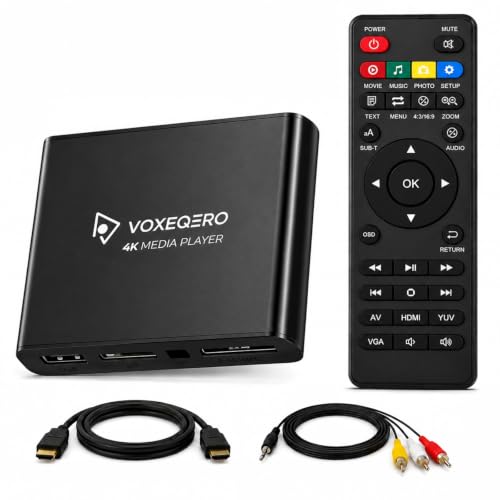 4K Media Player for TV
- Enjoy smooth playback of your personal video, music,…
- Automatically starts playback when powered on and remembers…
- Connect easily to modern TVs through HDMI or…
| Product | Key specs | |
|---|---|---|
| AGPTEK Updated 4K@30hz HDMI TV Media Player | 【4K@30hz Media Player】-- New updated 4K@30hz HD video… 【HDMI / VGA /AV Output】-- There are HDMI… 【Supports simultaneous HDMI/VGA output】-- HDMI and VGA can… | Check price |
| NEUMI Atom 4K Lite Digital Trigger Media | 【SIMPLE, POWERFUL, COMPACT】- Easily play videos, photos, and… 【4K/UHD VIDEO PLAYBACK】- Stunning HDMI video quality up… 【READS USB DRIVES AND SD CARDS】- Reads USB… | Check price |
| 4K Media Player for TV | Enjoy smooth playback of your personal video, music,… Automatically starts playback when powered on and remembers… Connect easily to modern TVs through HDMI or… | Check price |
 Micca 4K Ultra-HD USB and microSD Media Micca 4K Ultra-HD USB and microSD Media | Enhance any TV with the ability to play… Works with TVs old and new! Smoothly plays… Play media files from USB flash drives and… | Check price |
 HDMI Media Player HDMI Media Player | 【Mini Portable Media player】-- Fits into the palm… 【1080P MP4 Player】-- Full HD 1080p@60Hz supports most… 【HDMI or AV Output】-- Supports 1080p HDMI output,… | Check price |
 HDMI Media Player HDMI Media Player | 【HDMI Media Player】This 4K HDMI media player can… 【SD Card Reader and USB Port】This 4K media… 【H.265 Decoding】The powerful decoding chip is basically compatible… | Check price |
 4K Full-HD USB and microSD Digital Media 4K Full-HD USB and microSD Digital Media | [Smooth 4K Ultra HD Playback] This 4K@30Hz HDMI… [Plug and Play] The HD media player is… [HDMI RCA Optical Outputs] This media player connects… | Check price |
 4K Ultra HD Media Player 2-in-1 HDD 4K Ultra HD Media Player 2-in-1 HDD | Mini Simple Digital Signage - Great for digital… Simple, Compact but Powerful,JLZNLC 4K Media Player makes… Rich Media Formats Supported - Videos: MKV, MP4/M4V,… | Check price |
As an Amazon Associate we earn from qualifying purchases at no extra cost to you.
Quick Picks
| Product | Best for | Price |
|---|---|---|
| AGPTEK Updated 4K TV Media Player | Versatile multi-output setups | $59.99 |
| NEUMI Atom 4K Lite | Compact USB and SD playback | $45.99 |
| 4K Media Player with Auto Resume | Long-form content without losing position | $49.99 |
| Micca 4K Ultra-HD | Digital signage and retail loops | $54.99 |
| Black Mini 1080p HDMI Player | Tightest budget and simplest needs | $39.99 |
| 4K Ultra HD H.265 Media Player | Broad codec compatibility on a budget | $42.99 |
| 4K Full-HD USB microSD Player | Signage with dual media slots | $43.99 |
| 4K Ultra HD 2-in-1 HDD Enclosure Player | Playing directly from SATA hard drives | $69.99 |
How We Picked
We compared published specification sheets, manufacturer-claimed codec and output details, listed retail prices, and recurring themes in owner reviews. The four criteria that most strongly separate these products are: maximum video output (4K versus 1080p matters if your TV is 4K), codec breadth (H.265/HEVC support determines whether large modern files play at all), auto resume and loop behavior (critical for signage or multi-hour content), and physical media flexibility (number and type of drive, card, and USB inputs). Price was used as a tiebreaker, not a proxy for quality.
The 8 Best Windows Media Player Update in 2026
AGPTEK Updated 4K@30Hz HDMI TV Media Player
This unit targets buyers who need flexibility in how they connect to a display. With HDMI, AV, and VGA outputs, it is one of the few players on this list that can feed an older CRT or projector alongside a modern 4K television.
- Pro: Three output options (HDMI, AV, VGA) make it backward-compatible with legacy displays.
- Pro: 4K@30Hz output handles most home-video content without frame-rate judder at standard resolutions.
- Con: 30Hz ceiling means it is not suitable for 4K@60 source material.
Skip it if your display is 1080p and you want the lowest price, or if you need 60Hz 4K output for motion-heavy content. It is priced above several competitors that offer identical resolution for simpler use cases.
NEUMI Atom 4K Lite Digital Trigger Media Player
The Atom 4K Lite is built for users who swap USB drives and SD cards frequently—think small businesses updating promotional content or travelers with large media libraries. Its trigger function lets external signals start playback, adding automation to a manual device.
- Pro: Dual USB and SD card slots allow simultaneous media sources without a hub.
- Pro: Trigger input enables automated playback in kiosk or signage contexts.
- Con: “Lite” designation suggests a narrower codec list than the higher-end 4K players on this list.
Skip it if you primarily use a single large hard drive rather than swappable cards, or if you require verified H.265 decoding for the largest file types.
4K Media Player for TV, USB SD Playback, Auto Resume
This product earns attention for one headline feature that owners repeatedly praise: auto resume. For anyone watching multi-hour films or episodic content stored locally, losing your place is the most common frustration with basic players, and this unit eliminates it.
- Pro: Auto resume restores playback position, reducing friction for long-form content.
- Pro: HDMI and AV outputs cover both modern and older televisions.
- Con: Minimal brand presence in reviews makes firmware-update expectations uncertain.
Skip it if you need verified long-term software support, digital signage loop modes, or a specific codec that the product page does not confirm. The price is reasonable, but the lack of a recognizable manufacturer name is a real consideration.
Micca 4K Ultra-HD USB and microSD Media Player
Micca has established a reputation in the media-player niche, and this model leans into digital signage as its primary use case. Loop playback, scheduling, and broad file-format acceptance appear consistently in owner feedback as strengths.
- Pro: Built-in digital signage mode simplifies kiosk and retail deployments.
- Pro: Micca’s support reputation gives confidence in firmware longevity relative to no-name alternatives.
- Con: Priced above the gapless codec-comparison models that serve purely home use.
Skip it if you only need occasional home playback and do not want to pay a small premium for signage features you will never activate. For anyone running an ad loop, however, it justifies the cost.
HDMI Media Player, Black Mini 1080p Full-HD
This is the simplest option in the lineup: a compact 1080p player for anyone who wants to play media from USB storage on an existing HD television without complexity. Owner feedback centers on ease of setup and small form factor.
- Pro: Lowest price on this list makes it a low-risk entry point.
- Pro: Tiny footprint suits installations behind a TV or on a shelf with no visual space.
- Con: 1080p output limits it to non-4K displays and upscaling only.
Skip it if your television is 4K and you want native sharpness, or if your library includes large H.265 files that may exceed its decoding capability. It solves the basic problem at the lowest cost, nothing more.
HDMI Media Player, 4K Ultra HD Digital Media Player
At just above forty dollars, this player lists an unusually wide codec set—H.265, H.264, AVC, MP4, MKV, MP3, AVI, TS, RMVB, MOV, ISO, and JPG—which owners highlight as the main reason they chose it over pricier units with narrower specs.
- Pro: Explicit H.265/HEVC decoding at a price far below many competitors claiming the same feature.
- Pro: ISO and RMVB support covers legacy and disc-image files that most players ignore.
- Con: No recognized brand or published firmware-update history in available documentation.
Skip it if you prioritize manufacturer support, warranty clarity, or signage-specific loop modes. For a home user with diverse file formats, the codec breadth at this price is hard to argue against.
4K Full-HD USB and microSD Digital Media Player for TV Digital Signage
This model sits in a middle ground between the budget players and the Micca signage unit. It advertises both USB and microSD inputs alongside a signage focus, targeting small offices or retail spaces that update content by swapping cards rather than plugging in a USB stick.
- Pro: SD card slot allows content updates without removing a USB drive from the unit.
- Pro: Signage mode supports looping and scheduling for unattended display.
- Con: Less documentation and owner review volume than the Micca alternative.
Skip it if you have no signage requirement and want the absolute lowest price for home playback, or if you prefer a well-known brand with active support channels.
4K Ultra HD Media Player 2-in-1 HDD Enclosure
This is the only product on the list that combines a media player with a SATA hard-drive enclosure, supporting 2-inch, 2.5-inch, and 3-inch drives directly. It targets users with large media archives who do not want to copy content to flash storage before playback.
- Pro: Plays directly from SATA HDDs, eliminating the copy step that flash-based players require.
- Pro: H.265/HEVC and H.264/AVC decoding plus auto play and resume handle large file sets reliably.
- Con: Highest price on the list, and drive compatibility limits (no 3.5-inch desktop drives) may surprise buyers.
Skip it if your library already fits on a USB stick or SD card, or if you have full-size 3.5-inch desktop drives, since the support range covers smaller form factors. For anyone sitting on a shelf of old laptop or portable drives, the 2-in-1 design saves time and money.
Buying Guide
Output Resolution and Frame Rate
If your television is 4K, match the player to it. Several units here output 4K at 30Hz, which is fine for films and general video but noticeably limited for fast-motion content or when the TV expects a 60Hz handshake. The single 1080p model is a legitimate choice for HD displays and saves money. Check whether the player downscales intelligently when you feed it mixed-resolution content; owner reports on judder or black-screen handshake issues are worth scanning before purchase.
Codec and Container Support
H.265/HEVC is the codec that separates modern players from older stock. Large 4K files encoded in HEVC will refuse to play on H.264-only units, causing silent failures or error messages. If your library includes MKV containers, ISO disc images, or older RMVB and AVI files, verify those extensions appear explicitly in the spec sheet rather than in a vague “multi-format support” claim. The product listing for the $42.99 unit is the most explicit on this point.
Storage Flexibility and Auto Resume
USB stick capacity, SD card slot presence, and direct SATA drive support each serve different workflows. Auto resume, found on the $49.99 model and others, matters more than most buyers expect: without it, pausing a two-hour movie and powering off means restarting from zero. For signage loops, look for explicit repeat or scheduling modes rather than assuming auto resume covers that need.
Our Verdict
The top pick for most buyers is the 4K Ultra HD H.265 Media Player at $42.99. Its published codec list is the broadest in this group, it supports 4K output, and its price undercuts nearly every alternative while matching or exceeding their format compatibility.
The budget pick is the Black Mini 1080p at $39.99—three dollars less and a simpler device, appropriate for anyone whose display is HD and whose files are standard MP4.
The 2-in-1 HDD Enclosure at $69.99 wins outright for one condition: if you hold media on legacy SATA drives and do not want to migrate files to flash storage, no other product on this list plays directly from bare drives.
FAQ
Do I need a media player if my TV already plays USB files?
Many modern TVs accept USB media, but their built-in firmware supports a narrow codec set and often fails on H.265/HEVC, ISO, or less common containers like RMVB. A dedicated player guarantees broader compatibility and typically handles larger file sizes without stuttering.
Will a media player improve picture quality on my existing TV?
The player decodes the file and outputs a signal; it does not add detail beyond the source resolution. A 4K player on a 4K TV will display native sharpness, while a 1080p player on the same screen will show upscaling artifacts. Match the player’s output to your display’s native resolution.
Can I use any USB drive or SD card with these players?
Formatting matters more than brand. Most players in this category expect FAT32 or exFAT file systems, and very large NTFS volumes occasionally cause navigation issues. Check the product manual for maximum supported drive capacity before inserting a multi-terabyte HDD without an external power adapter.
Is a Windows media player update still relevant when hardware players exist?
Software players on a PC handle codec management automatically through framework updates, but they require a running computer, which is impractical for signage, guest rooms, or kitchen counters. A hardware player is a set-and-forget alternative that avoids driver and OS dependencies entirely.