Key takeaways
- Table of Contents 5 sections 9 min read 1 Quick Verdict 2 Hevea vs Acacia Side by Side 3 How to Choose 3.1 Start with thickness, not species 3.2 Price per square foot, with thickness noted 3.3 Think about what…
Walk through the affordable end of the butcher block market and you will meet the same two woods over and over: hevea, sold as rubberwood or parawood, and acacia. Both arrive as edge-glued or finger-jointed slabs, usually 1 to 1.5 inches thick, usually unfinished, and usually priced far below hard maple or walnut. For a workbench top, a standing desk, or a laundry counter, they are the practical choices. They are not, however, interchangeable.
The difference comes down to three things: hardness, color and grain consistency, and how each behaves when your shop or garage swings from dry winter heat to humid summer. Hevea is the lighter, blonder, cheaper, more uniform wood and the easier one to finish evenly. Acacia is the harder, darker, more figured wood that costs more per square foot and looks better under a clear finish but asks more of you at installation. Below is a straight comparison with real slab prices, plus what each is genuinely better at.

HEVEA Baby & Toddler Bath Mat - 100% Natural Rubber Non Slip Bathtub Mat for Baby - Upcycled, Danish Design - Safe & Sustainable Bathroom Essential (Natural)
Selected for "hevea vs acacia wood for a workbench": this listing is a general product (HEVEA Baby & Toddler Bath Mat - 100% Natural Rubber Non Slip Bathtub Mat for Bab), matching the product category this article compares.
View on Amazon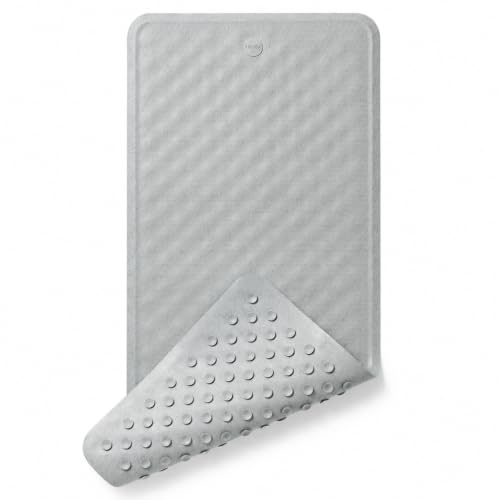
HEVEA Natural Rubber Big Bath Mat - Upcycled, Danish Design - Non Slip Bathtub Mat, 299 Suction Cups - Safe and Friendly Shower Mat for All Ages (Granite)
Selected for "hevea vs acacia wood for a workbench": this listing is a general product (HEVEA Natural Rubber Big Bath Mat - Upcycled, Danish Design - Non Slip Bathtub M), matching the product category this article compares.
View on Amazon
HEVEA Standard Neck Glass Baby Bottle - Slow Flow Anti Colic Baby Bottles 0-3 months - Eco-friendly, BPA-free, Two-pack (4 Oz)
Selected for "hevea vs acacia wood for a workbench": this listing is a general product (HEVEA Standard Neck Glass Baby Bottle - Slow Flow Anti Colic Baby Bottles 0-3 mo), matching the product category this article compares.
View on Amazon
HEVEA Natural Rubber Wave Bath Mat – Long 28 × 16 in - Non-Slip Shower & Bathtub Mat with 388 Suction Cups, Plastic-Free & Biodegradable (Sand)
Selected for "hevea vs acacia wood for a workbench": this listing is a general product (HEVEA Natural Rubber Wave Bath Mat – Long 28 × 16 in - Non-Slip Shower & Bathtub), matching the product category this article compares.
View on AmazonQuick Verdict
For most workbenches, hevea wins on value and predictability. The Oenalw 48″ x 30″ Rubberwood Butcher Block Countertop at $129 works out to roughly $12.90 per square foot, which is the cheapest solid-wood slab in this comparison, and the Oenalw 36″ x 25″ at $99.99 is the entry point for a compact bench. Hevea’s uniform, pale, straight grain takes stain and oil evenly with almost no blotching, and it is easy to plane and sand flat.
For a bench that doubles as visible furniture or will take real abuse, acacia is worth the premium. The FLEXISPOT Acacia 55″ x 28″ Butcher Block Desktop at $179.99 and the 72″ x 30″ at $349.99 give you a harder surface with far more grain character. Acacia dents less readily under dropped tools, and its natural color variation hides marks that would show clearly on blond hevea.
If you want the decision made for you, the Olympia Tools Acacia Workbench at $169.99 arrives as a complete 48-inch bench with a built-in vise and a drawer. That is less than the cost of a bare 72-inch acacia slab, and it removes the base-building problem entirely.
Hevea vs Acacia Side by Side
| Factor | Hevea (rubberwood / parawood) | Acacia |
|---|---|---|
| Hardness | Moderate; a medium-hard hardwood, roughly comparable to cherry or soft maple on published Janka figures | Generally harder; commercial acacia species typically test well above hevea, though the genus varies a lot by species |
| Color | Pale blond to light cream, very uniform | Golden brown to dark chocolate, high contrast between boards |
| Grain | Straight, tight, consistent; few surprises | Variable, often wavy or interlocked; more figure |
| Dimensional stability | Good once properly kiln dried; uniform grain moves evenly | Good, but interlocked grain and color-mixed boards can move unevenly if the slab is not acclimated |
| Dent resistance | Moderate – dropped sockets leave marks | Better – the practical reason to pay more |
| Natural decay and insect resistance | Low; hevea needs a finish and must stay dry | Higher; many acacia species are naturally more durable |
| Finishing | Very forgiving; stains and oils evenly, minimal blotch | Trickier; dense figured areas absorb unevenly, oil deepens contrast dramatically |
| Typical slab price | About $13 to $24 per sq ft at retail | About $14 to $26 per sq ft at retail |
| Weight | Lighter; a 72 x 30 slab is a two-person lift but manageable | Heavier for the same size |
| Best for | Shop benches, laundry counters, painted or stained tops, budget builds | Standing desks, visible benches, tops that stay natural under clear finish |
How to Choose
Start with thickness, not species
A 1.5-inch slab is stiff enough to span between a pair of cabinets or a standard bench frame without visible deflection. A 0.7-inch or 1-inch panel is a desktop, not a workbench – it needs continuous support or a stretcher every 24 inches or so. The Howizz acacia 48″ x 25″ comes in both a 0.7-inch version at $119 and a 1-inch version at $134.80, and that $16 is the cheapest stiffness you will ever buy. For anything you will hammer on, hold out for 1.5 inches: the AllForWood Hevea 48″ x 30″ x 1.5″ at $179.99 or the Howizz Acacia 96″ x 25″ x 1.5″ at $435.10.
Price per square foot, with thickness noted
Sticker price hides the real comparison. The Oenalw hevea 48 x 30 at $129 is about $12.90 per square foot. The AllForWood hevea 72 x 30 at $289.99 is about $19.33. The FLEXISPOT acacia 55 x 28 at $179.99 is about $16.83, and the Howizz acacia 96 x 25 x 1.5 at $435.10 is about $26.11. The pattern is consistent: hevea undercuts acacia at similar sizes, and larger slabs cost more per square foot in both woods because big defect-free stock is harder to source.
Think about what you will drop on it
This is the single most practical reason to choose acacia. A workbench accumulates dents. Hevea’s moderate hardness means a dropped wrench leaves a visible dimple; acacia’s greater density resists it better, and its darker, busier grain camouflages what does get through. If your bench is for electronics, sewing, or folding laundry, this argument evaporates and hevea is the better buy.
Consider how you want it to look in five years
Hevea is pale and will yellow noticeably under an oil-based finish. That is not a flaw, but it means a blond, Scandinavian look needs a water-based clear coat such as a satin water-based polyurethane rather than oil. Acacia deepens and richens under oil, and the color variation between boards – which some people love and some find busy – becomes more pronounced. Look at photographs of finished slabs, not raw ones, before deciding.
Acclimate the slab before you fasten anything
Both woods arrive from a controlled environment and both will move as they equalize with your space. Lay the slab flat, supported evenly, in the room where it will live, for at least 3 to 5 days before cutting or mounting. Then finish all six surfaces – top, bottom, and all four edges – on the same day. A slab finished on one face only absorbs moisture unevenly and cups, and that is the most common cause of a “warped” butcher block, in either species.
Fasten for movement, not against it
Solid wood expands and contracts across its width, not its length. Mount the top to its base with elongated slots or figure-eight fasteners so it can breathe. Bolting a 30-inch-wide slab rigidly at both edges is a reliable way to crack it, and it does not matter which wood you bought.
The Picks in Detail
Oenalw 36″ x 25″ Rubberwood Butcher Block – $99.99. The cheapest way into a real solid-wood top. Around 6.25 square feet, enough for a compact garage bench, a laundry counter over a washer and dryer, or a small standing desk. Unfinished, so budget for oil.
Oenalw 48″ x 30″ Rubberwood Butcher Block – $129. The value champion at roughly $12.90 per square foot. Thirty inches of depth is genuinely useful on a workbench, giving you a clamping zone at the front and a tool strip at the back.
Hevea Butcher Block, 30″ x 25″ x 1.5″ – $125.99. Small but properly thick. This is the one for a heavy-duty bench in a tight space, or a sturdy side table for a vise.
AllForWood Hevea 48″ x 30″ x 1.5″, unfinished – $179.99. The best-balanced hevea slab here. Full 1.5-inch thickness, generous depth, and unfinished so you choose the look. AllForWood Hevea 72″ x 30″ x 1.5″ at $289.99 scales it up to a full-length bench for about $19 per square foot.
Howizz Hevea Butcher Block 72″ x 25″ x 1.5″ – $283.60. A narrower long slab. Twenty-five inches suits a bench against a wall where you want length rather than reach.
BingLTD 10 ft Hevea Butcher Block, 120″ x 25″ x 1.5″ – $699.99. The one-piece answer for a long wall or a shared bench. Ten feet of continuous solid wood is a two-person carry and needs support roughly every 30 to 36 inches.
Howizz Acacia 48″ x 25″, teak stained, 1 inch – $134.80. Pre-stained, so the finishing work is partly done and the color is consistent. Good for a desk; marginal as a pounding bench at 1 inch.
FLEXISPOT Acacia 55″ x 28″ Butcher Block Desktop – $179.99. Natural finish acacia at a fair price, sized for a standing desk frame. The 72″ x 30″ version at $349.99 is the full-size upgrade.
Howizz Acacia Butcher Block 96″ x 25″ x 1.5″, unfinished – $435.10. Eight feet of proper 1.5-inch acacia. The most workbench-appropriate acacia slab here, and the most expensive per square foot, which is the honest cost of hardness plus length.
Olympia Tools Acacia Workbench, 48 inch – $169.99. Complete bench with vise and drawer. If you do not already own a base, this beats buying a slab and building legs in both money and weekends.
Related guides: best oil for a butcher block workbench, does aromatic cedar stain clothes, best bed frame that does not squeak, mattress topper thickness guide, memory foam vs hybrid mattress topper
FAQ
Is rubberwood a low-quality wood?
No, though the name works against it. Hevea brasiliensis is a genuine hardwood harvested from latex plantations after the trees stop producing, which is why it is cheap and why it is often marketed as sustainable. It is stable, machines cleanly, and takes finish beautifully. Its real weaknesses are moderate hardness and low natural resistance to decay and insects – meaning it must be finished and kept dry, and it is a poor choice for anything outdoors or in a damp basement.
Which one holds up better to water spills?
Acacia, marginally, because many acacia species have higher natural durability. But the finish matters far more than the species. An oiled hevea top wiped promptly is fine; an unfinished acacia top left with a puddle on it will stain and swell. If water is a regular event, use a film finish or a well-built oil finish and wipe spills rather than relying on the wood.
Can I cut food on either of these?
Both are used for cutting boards and butcher block countertops, so yes in principle, provided you finish with a food-safe product such as food-grade mineral oil, a beeswax and mineral oil cream, or fully cured 100% tung oil. But a workbench that sees solvents, adhesives, and metal filings should not be a food prep surface regardless of species. Keep those jobs separate.
Why do the boards in my acacia slab look so different from each other?
Because acacia is sold as a trade name across several species, and even within one species the heartwood and sapwood differ sharply in color. Manufacturers generally do not sort for uniformity at this price point. If a consistent look matters to you, hevea is the safer purchase; if you like the variegated look, acacia delivers it for free.
Do I need to flatten the slab before installing it?
Usually not, but check it. Lay a straightedge across the width and along the length after acclimation. Minor cup can be pulled flat by the base if you fasten across it; serious cup needs a hand plane, a belt sander, or a router sled. Do this before you finish, not after, and finish all six faces the same day to lock in the flatness.