Key takeaways
- Condition decides the project. The best ideas for old headboards and footboards depend on whether the piece is wood or metal, sound or soft, and whether its paint predates 1978, because a weak frame can still become a garden trellis…
Condition decides the project. The best ideas for old headboards and footboards depend on whether the piece is wood or metal, sound or soft, and whether its paint predates 1978, because a weak frame can still become a garden trellis but should never be turned into a bench.
As an Amazon Associate we earn from qualifying purchases.
By KK Home Furnishings Editorial Team
Quick, Practical Ideas for Old Headboards and Footboards
The four ideas below need a weekend rather than a workshop, and three of the four end up on a wall instead of carrying anybody’s weight. Each lists the measurement its own source project actually used, because an old bed part is not a standard size in any direction at all.
| Idea | Space or Size Needed | Cost Tier | Effort and Time |
|---|---|---|---|
| Entryway bench | Around 18 in of seat height and depth as a target | Low to mid | Medium, with a new load-bearing frame |
| Patio bench from a footboard | Footboard sides cut at 18 in in the cited project | Low to mid | Medium, plus 1×4 and 1×6 lumber |
| Shelf and coat rack | A shelf board such as a 1×6 | Low | Low to medium |
| Heavy wall display shelf | A wall able to carry the finished weight | Low to mid | Medium, with reinforcement and D-rings |
| Chalkboard message centre | A flat panel large enough to write on | Low | Low, over several paint coats |
| Footboard hook rack | Wall width roughly matching the footboard | Low | Low |
| Raised-planter trellis | A 4 ft planter per section in the cited project | Mid | Medium, including rebar posts |
| Freestanding garden trellis | Soil plus rebar or stake support | Low | Low to medium |
Turn the Headboard Into an Entryway Bench
A seat height and depth of around 18 inches is the practical target used across several DIY bench guides, and it is a starting point rather than a rule, since cushion thickness and the height of whoever sits there will both move it. Measure against a dining chair you already find comfortable.
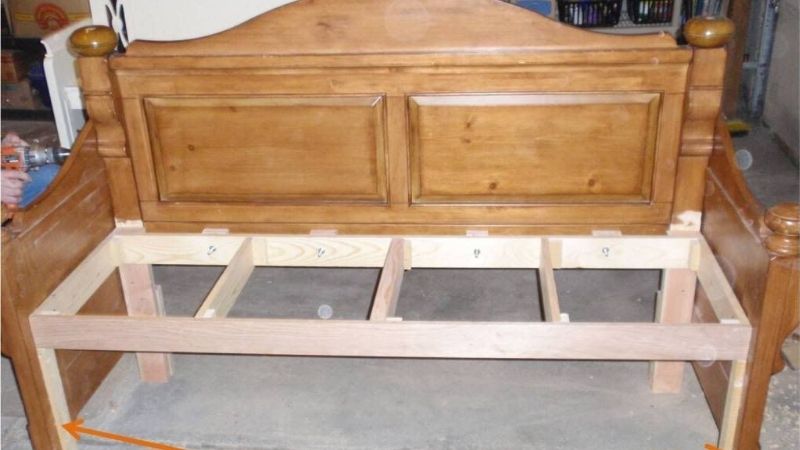
Build a separate load-bearing frame for the seat rather than assuming the headboard can carry it. The headboard becomes the back, where it holds no weight beyond someone leaning on it, and the legs, apron and seat platform are all new timber sized for the load they will actually take.
Use the Footboard as Bench Sides
One documented patio-bench project cuts each footboard side down to 18 inches and then completes the frame in 1×4 and 1×6 lumber. Splitting a footboard in two gives you a perfectly matching pair of ends, which is why this idea works better with a footboard than with a single headboard panel.
Check the cut line against the joinery before marking it, because cutting through a mortise or a dowel joint leaves an end with nothing holding it together. Outdoors, seal the fresh end grain as well as the faces, since end grain is where water gets into timber first and fastest.
Add a Shelf and Coat Hooks
A cited headboard coat-rack project adds a 1×6 shelf board across the top, fixed with pocket-hole screws, and drills pilot holes for every hook before fitting any of them. Those pilot holes matter on old timber, which splits far more readily than new stock does when a screw is driven in dry.
Position the hooks over the solid rails rather than over any thin infill panel, and work out the hook height before fixing anything at all to the wall. A coat rack hung at full headboard height usually puts the hooks too high for children, which is worth deciding before any holes get drilled.
Make a Heavy Wall Display Shelf
One project reinforces the back of the piece before fitting heavy-duty D-rings to it, and finishes the whole thing with two light coats of primer followed by two top coats. The reinforcement is the part people tend to skip, and it is what the hanging hardware actually gets screwed into.
Match the fixings to the finished weight and to the wall itself rather than to whatever hardware came in the pack. A piece heavy enough to need D-rings is heavy enough to need studs or proper cavity anchors, and the total weight only goes up once the shelf has anything standing on it.
Bigger-Impact Repurposing Ideas
These last four either change the piece permanently or move it outdoors for good, and both of those raise the stakes on the preparation. Two involve paint over an old finish and two put metal into soil, and both bring conditions that the quicker projects above avoid entirely.
Convert a Headboard Into a Chalkboard Message Centre
One documented project uses three to four coats of chalkboard paint across the panel, then adds a narrow ledge along the bottom edge for chalk and an eraser. A panelled headboard works far better than a slatted one here, because the writing surface has to be continuous to be useful.
Preparation is where this succeeds or fails. The surface has to be sanded flat and then primed before the chalkboard paint will key properly, and that is exactly the step which triggers the lead-paint question on anything older than 1978, so settle it before the sander comes out.
Turn a Footboard Into a Wall-Mounted Hook Rack
A documented rack of this kind uses two D-rings set on 16-inch centres, plus a third D-ring higher up the piece. That spacing suited the stud layout in the project it came from, and it remains that project’s configuration rather than a prescription for hanging furniture on any wall.
Find your own studs and set the hardware to match those instead of copying the published numbers across. A footboard is lighter than a headboard and sits shallower on the wall, which makes it the easier of the two to hang and more forgiving of a first position that turns out wrong.
Build a Raised-Planter Trellis
A recent project pairs a full-size metal headboard and footboard with two four-foot galvanised planters, using four rebar posts in total, which works out at two posts per trellis section once the bed is split. It also leaves a gap of one to two inches between the planter and the metalwork.
That small gap matters more than it looks, because metal sitting hard against a damp planter wall corrodes faster and makes the planter harder to move or refill later on. Drive the rebar before the planter gets filled, since a loaded raised bed is not something anyone repositions.
Use a Metal Headboard as a Standalone Garden Trellis
A metal bed frame makes a usable support for climbing plants with almost no modification at all, which makes it the lowest-effort idea in this list. Outdoor guidance recommends adding rebar or stake supports wherever the soil or the setup needs them, so the structure does not go over.
Weigh up the plant as well as the frame here before siting it. A mature climber in full leaf catches the wind like a sail, and a decorative headboard pushed into soft ground will lean long before the metal gives way, which is the failure this one shares with every freestanding garden structure.
Frequently Asked Questions
Two of these questions are about measurement, one is about the preparation step most people skip entirely, and the last is about what the whole exercise actually costs you to do. Every figure quoted below comes from a named project rather than from any general rule about old bed parts.
What Is a Good Height for a Headboard Bench?
Around 18 inches of seat height is the figure several DIY bench guides use as a working target, and it sits close to the seat height of a dining chair for most adults. Treat it as a starting point rather than a target, because cushion thickness and the height of the people using it both shift the result.
Measure a seat you already find comfortable and work from that number instead. Depth matters alongside height here: around 18 inches gives room to sit back without the bench projecting far into a hallway, and depth is usually the real constraint in an entryway rather than height.
Can I Sand an Old Painted Headboard?
Not without checking the paint first. The EPA warns that disturbing lead-based paint by sanding or cutting it can create hazardous dust and chips, and anything painted before 1978, or of genuinely unknown origin, should be handled using lead-safe practices rather than sanded casually in a garage.
Where the paint history is unknown, test it first or pick a project that does not disturb the surface at all. A headboard can become a trellis, a hook rack or a planter backdrop with no sanding whatsoever, which sidesteps the question entirely rather than managing it.
How Do I Stabilise a Metal Headboard Outdoors?
The cited raised-planter project uses two rebar posts per headboard section, driven into the ground alongside the frame. Other outdoor guidance recommends adding rebar or stakes wherever the soil is soft, or the structure is tall enough to catch the wind once plants have grown over it.
Drive the posts deeper than feels necessary and tie the frame to them in at least two separate places rather than one. Check those ties at the end of every season, because a trellis that felt solid in spring will be carrying several kilos of wet foliage by late summer.
What Does Repurposing a Headboard Actually Cost?
Most of these projects sit in a low cost tier, because the main component is something you already own. The two bench projects are the exception and reach a mid tier, since they need new lumber for the frame, while the display shelf adds reinforcement timber plus heavy-duty hanging hardware.
Renters should weigh up the wall-mounted ideas carefully, since D-rings driven into studs mean holes to make good later on. The garden trellis, the freestanding planter backdrop and a chalkboard leaned against a wall all avoid drilling entirely, which makes them the safer picks on a tenancy.
Final Thoughts
Test the piece before choosing the project. Push hard on a joint, check for soft timber down at the feet and look closely for rust at the welds, because any ideas for old headboards and footboards that involve sitting on the thing belong only to frames that pass that check first.