Key takeaways
- The number that matters is not what the motor lifts but what you can actually load, since the platform’s own weight eats into the rating. A good garage storage lifter separates gross lift from usable cargo, so you know how…
The number that matters is not what the motor lifts but what you can actually load, since the platform’s own weight eats into the rating. A good garage storage lifter separates gross lift from usable cargo, so you know how many pounds of bins and gear it really raises to the ceiling, not just the headline figure.
As an Amazon Associate we earn from qualifying purchases.
By KK Home Furnishings Editorial Team
How to Choose a Garage Storage Lifter
A ceiling lift is judged on usable cargo, not gross lift, and on how it mounts to your structure. The criteria below start with the gross-versus-usable distinction and the platform, then cover the drop and ceiling height, and the structural attachment that makes this a safety decision rather than a simple purchase.
Gross Lift Versus Usable Cargo
Read the capacity carefully, because gross lift and usable cargo are different. The platform itself weighs something, so the Garage Smart lists 400 pounds gross including a 35-pound platform, which leaves 365 pounds of usable cargo, the figure that actually limits your bins and boxes rather than the headline 400.
Subtract the platform weight from the gross rating to find what you can load. A lift that quotes only a gross figure hides that math, so ask for the platform weight and do the subtraction yourself, since the difference between gross and usable is the gap most buyers miss until the loaded platform refuses to budge.
Also note whether a capacity is stated as distributed or concentrated. The CeilingSAM lists 400 pounds distributed, meaning the load must be spread evenly across its platform rather than piled in one spot, so judge a lift by the usable cargo under the load pattern you will actually use, not by a single large number.
Platform Size and the Load It Holds
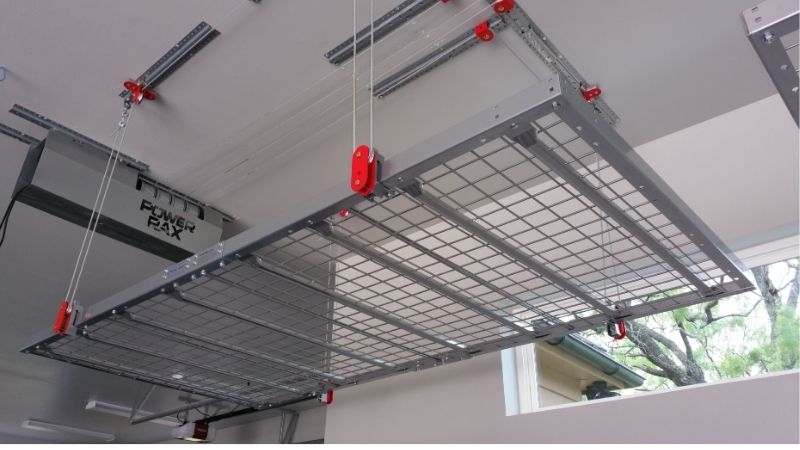
Platform size decides what fits as much as the weight rating does. These range from the Garage Smart’s 16 square feet to the CeilingSAM’s 32-square-foot 4-by-8 platform, with the SkyLift offering several sizes from 3-by-6 up to 4-by-8, so match the deck to the bins, kayaks, or seasonal totes you plan to store overhead.
A larger platform spreads a distributed load and fits bulky items, but it also needs the capacity to match, since a big deck loaded fully still has to stay under the usable cargo figure. Measure your largest items and tally their weight, then confirm both the footprint and the usable capacity cover them with margin.
The Auxx Attic-Lift offers two platform sizes, so choosing the deck is part of sizing the lift to your garage. Think about how you load and unload, too, since a wide platform at ceiling height is harder to reach across, and a smaller deck you can load evenly may be more practical than the largest one available.
Drop, Ceiling Height and Reach
Travel distance has to match your ceiling, so check the drop range. The SkyLift lowers up to about 13.5 feet, the CeilingSAM around 8 feet, and the Auxx Attic-Lift travels roughly 12 to 18 feet, so measure from your ceiling or attic opening to where you will load the platform before assuming a lift reaches far enough down.
A longer drop suits a tall garage or an attic lift that descends through a hatch, while a shorter drop fits a standard ceiling. Confirm the lowered platform sits at a height you can safely load without overreaching, since a platform that stops too high leaves you lifting heavy bins overhead, which defeats the point of a lift.
Account for what hangs below the raised platform, too. Stored items plus the platform must clear vehicles, doors, and lights when fully raised, so measure the raised height and the clearance beneath it, and plan the footprint so a car or garage door never meets the loaded platform on its way up or down.
Structural Attachment and Safety
The attachment to your ceiling or framing is the real safety decision, so follow the manufacturer’s instructions exactly. These lifts mount into structural members, and the CeilingSAM is drill-powered for installation, so confirm your joists or trusses can carry the loaded weight and that you fix into structure, not just drywall or a single beam.
Never exceed the usable cargo rating, and distribute the load as the maker specifies, since a concentrated pile can overload one point even below the total figure. If you are unsure your ceiling structure is adequate, have it assessed before installing, because a failure overhead is far more serious than a shelf that bends at floor level.
Treat the lift as equipment with limits, not a shortcut. Check the hardware periodically for wear, keep people and vehicles clear while it moves, and respect the capacity and load pattern on every use, since the whole point of overhead storage is that it stays overhead safely rather than coming down unexpectedly on what is below.
Top Picks
Each pick leads with usable cargo capacity and platform size, the real measures of a garage storage lifter, plus the trade-off worth knowing. Capacity figures mean little without the platform weight and load pattern, so read each as usable cargo under the stated conditions rather than as a gross headline number to pile against.
| Product | Best For | Key Spec | Watch Out For |
|---|---|---|---|
| Garage Smart 4×4 | Best overall | 365 lb usable cargo; 16 sq ft | 400 lb gross includes a 35-lb platform |
| SkyLift | Best for a tall garage | 400 or 600 lb motor; up to 13.5 ft drop | Capacity depends on the motor you choose |
| CeilingSAM 4×8 | Best for large, flat items | 400 lb distributed; 32 sq ft; 8 ft drop | Load must be spread evenly, not piled |
| Auxx Attic-Lift | Best for high ceilings | 400 lb; 12–18 ft travel | Confirm framing per the install manual |
Garage Smart 4×4: Best Overall
The Garage Smart takes the top slot for clarity, listing 400 pounds gross including a 35-pound platform, which leaves 365 pounds of usable cargo on a 16-square-foot deck. It suits most garages storing bins and seasonal gear. It sits in the mid-to-premium tier, so confirm the current price before ordering.
Its advantage is that it states the usable figure plainly, so you know the real limit without guessing. Measure your heaviest load against the 365 pounds, confirm the 16-square-foot deck fits your items, and plan the mounting into structural framing per the instructions, since the install is what keeps the loaded platform overhead safely.
The honest caveat is the gross-versus-usable gap buyers often miss: the 400-pound headline includes the platform, so budget to 365 pounds of cargo. Distribute the load rather than piling it, follow the structural attachment steps exactly, and have your ceiling assessed if you are unsure it can carry the loaded weight overhead.
SkyLift: Best for a Tall Garage
The SkyLift is the pick for a tall garage, offering a 400- or 600-pound motor choice, platform sizes from 3-by-6 up to 4-by-8, and a drop of up to about 13.5 feet. It suits high ceilings and heavier loads. It sits in the premium tier, so confirm the live price and motor option before ordering.
Its advantage is flexibility: you choose the motor and platform to match your load and ceiling, and the long drop suits a tall space. Measure your ceiling height against the 13.5-foot drop, pick the motor that covers your usable cargo with margin, and remember the platform weight still counts against whichever motor rating you select.
The honest caveat is that capacity depends on the motor you choose, so a 400-pound unit is not the same as the 600-pound option, and the usable cargo is less than the motor rating once the platform is counted. Confirm the structural mount for the heavier configuration, since more capacity means more load on your ceiling framing.
CeilingSAM 4×8: Best for Large, Flat Items
The CeilingSAM is the pick for bulky, flat loads, with a 32-square-foot 4-by-8 platform rated to 400 pounds distributed, an 8-foot drop, and drill-powered installation. It suits plywood, long totes, or seasonal gear. It sits in the premium tier, so confirm the current price before choosing it for a large deck.
Its advantage is the large, even deck, which suits items a small platform cannot hold, and the drill-powered install simplifies setup into your framing. Spread the load evenly across the 32 square feet, since the 400-pound rating is distributed, and confirm the 8-foot drop reaches a comfortable loading height in your particular garage.
The honest caveat is that 400 pounds distributed is not 400 pounds in one spot, so a concentrated pile can overload the platform even under the total. Load it evenly, follow the structural attachment steps for the drill-powered mount, and confirm your joists carry the full load, since a big deck invites heavier loads than you expect.
Auxx Attic-Lift: Best for High Ceilings
The Auxx Attic-Lift is the pick for high ceilings and attic storage, rated to 400 pounds with two platform sizes and a long 12-to-18-foot travel. It suits a garage with an attic hatch or a very tall ceiling. It sits in the premium tier, so confirm the live price and platform choice before ordering.
Its advantage is the long travel, which lowers the platform from an attic or high ceiling to a loadable height, with two deck sizes to match your load. Measure the drop you need against the 12-to-18-foot range, choose the platform that fits your items, and confirm the lowered height lets you load without overreaching.
The honest caveat is the structural stakes of a long-drop attic lift: it must mount into adequate framing per the manual, and the 400-pound rating is before the platform weight. Confirm your attic or ceiling structure carries the loaded weight, distribute the load, and never exceed the usable cargo, since a long-drop failure is the most serious of all.
Frequently Asked Questions
Buyers adding overhead storage ask the same questions about capacity, fit, and safety. Each answer below opens with the short version, then the detail that changes it, so you can match a garage storage lifter to your real load and ceiling rather than to a gross number that overstates what you can safely raise.
Is the capacity the weight I can actually load?
Not quite. The gross figure usually includes the platform, so the usable cargo is less. The Garage Smart’s 400-pound gross includes a 35-pound platform, leaving 365 pounds for your bins, so subtract the platform weight from any gross rating to find what you can really load onto the lift.
Load pattern matters too. A rating stated as distributed, like the CeilingSAM’s 400 pounds, assumes the weight is spread evenly, so a concentrated pile can overload the platform even below that number. Read whether the figure is distributed or concentrated, and load the way the maker specifies rather than assuming any arrangement is fine.
To avoid surprises, tally your heaviest realistic load and compare it to the usable cargo with margin, not to the gross headline. If a listing quotes only a gross number, ask for the platform weight, since the gap between gross and usable is the single most common reason a loaded lift disappoints its owner.
How do I know my ceiling can hold it?
Confirm it against the manufacturer’s instructions and your framing. These lifts mount into structural members like joists or trusses, not drywall, and must carry the loaded weight plus the platform, so check that your structure meets the maker’s requirements before installing, and have it assessed by a professional if you are unsure.
The loaded weight is what matters, not the empty lift. Add the usable cargo, the platform, and the mechanism, then confirm your framing carries that total at the mounting points. A single beam or inadequate truss can fail even if the lift is rated correctly, so the attachment is the real safety decision here.
Follow the install steps exactly, including fasteners and spacing, since overhead failures are far more serious than a shelf bending at floor level. If your garage has engineered trusses or an unusual roof structure, confirm with the maker or a contractor that your specific framing suits the lift before drilling anything into it.
Is total capacity the same as per-platform load?
For a single-platform lift, the rating is the platform’s capacity, but read how it is measured. A distributed rating assumes an even spread, while a concentrated load in one spot can exceed what that area supports, so the total is not a license to pile everything in a corner of the deck.
Match the load to both the weight rating and the platform size. A large deck like the CeilingSAM’s 32 square feet spreads a distributed load well, but the 400-pound figure still caps the total, so a bigger platform does not mean a bigger weight limit unless the rating says so separately.
When in doubt, treat the usable cargo as the hard limit and spread the load evenly. That keeps you under both the total and any per-area limit, and it is the safe way to use a lift whose single number has to cover a whole platform of varied items raised over your head rather than resting on a floor, where a failure is far less serious.
Can I store anything I want up there?
Within the usable cargo and load pattern, mostly, but with sense. Overhead storage suits bins, seasonal gear, and bulky light items, as long as the total stays under the usable cargo and the load is distributed as the maker specifies. Avoid storing anything that could shift, leak, or fall onto a vehicle below.
Weight and balance matter more overhead than on a floor shelf. Keep heavy items centered and spread, not piled at one edge, and secure loose contents so nothing works free as the platform moves. Liquids, hazardous materials, and anything temperature-sensitive are poor choices for a hot garage ceiling regardless of the weight rating.
Finally, keep the area below clear while the lift operates, and check the hardware periodically for wear. The point of a garage lift is safe overhead storage, so respecting the capacity, distributing the load, and maintaining the mechanism are what keep stored items up where you put them rather than coming down unexpectedly.
Final Thoughts
The right garage storage lifter is the one whose usable cargo, after the platform weight, clears your heaviest load, not the biggest gross headline. Before ordering, subtract the platform weight to find the real capacity and confirm your ceiling framing meets the install instructions, since the overhead attachment is the real safety decision.