Shopping for a white dresser is easy to get wrong, because a painted-white unit and a white-oak piece look similar in a photo but are built and priced very differently. This guide compares four real models on finish type, actual depth and drawer construction so the one you buy matches the room and the use.
As an Amazon Associate we earn from qualifying purchases.
By KK Home Furnishings Editorial Team
How to Choose a White Dresser
A white dresser should be judged on more than color. Finish type sets the look and durability, depth decides how far it intrudes, and the drawer build determines how it feels for years. These four range from 48 to 66 inches wide and 16.73 to 19.5 inches deep, so measure the wall and define the finish first.
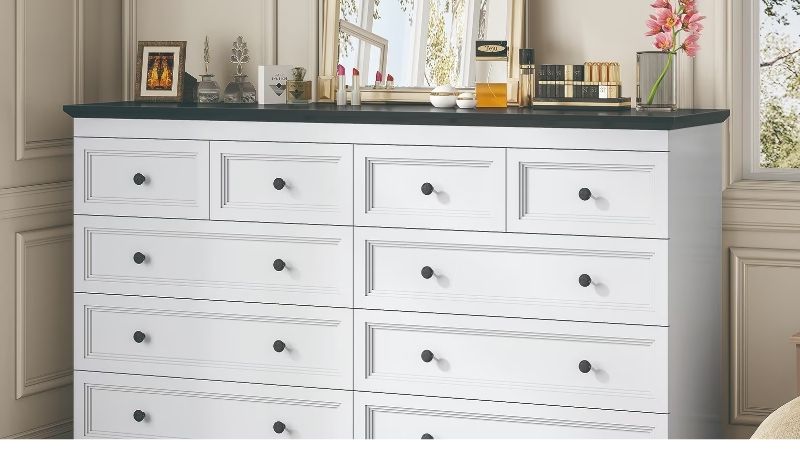
Decide Between Painted White and White Oak
Two very different finishes hide behind the word white. The Storkcraft Crescent and West Elm Pippa are painted white, giving a crisp, uniform surface, while the Article Prima and Leif are white oak, a pale wood with visible grain. Painted white reads cleaner; white oak reads warmer and more textured.
Pick based on the room and the mess it will see. Painted white suits a bright, minimal bedroom and hides seams well, but shows scuffs and is harder to touch up invisibly. White oak forgives small marks because the grain breaks up the surface, which can be the better call in a busier household or a kid’s room.
The two finishes are not interchangeable quality tiers, and neither is automatically more durable. Painted MDF and particleboard sold in the US must still meet formaldehyde limits under TSCA Title VI (EPA), so a budget painted dresser is not inherently worse; judge the substrate and joinery, not the color label alone.
Check Actual Depth, Not Just Looks
Depth varies more than the matching finishes suggest. Measured front to back, the Crescent is shallowest at 16.73 inches, the Pippa next at 18, the Prima at 19.25 and the Leif at 19.5, so the deepest pick reaches nearly three inches further into the room than the shallowest for a similar drawer count.
That gap matters in a tight bedroom. A shallow 16.73-inch body like the Crescent keeps a walkway clear beside a bed or door, while a deeper unit gives roomier drawers. Remember to add clearance for a pulled-out drawer, which extends the effective footprint by roughly the drawer’s own depth again when open.
Width compounds the effect: the Leif is 66 inches wide and the Pippa only 48, so footprints diverge sharply. An oversized dresser crammed into a small room gets bumped and dragged, which over time works engineered-wood joints loose, so err toward the depth and width your wall genuinely has rather than the largest you can afford.
Compare Drawer Construction and Glides
Drawer build separates these picks more than finish does. The Pippa runs six metal-glide drawers around 21.4 by 14.2 by 6 inches on a solid frame with engineered panels; the Prima and Leif use soft-close drawers; and the Crescent pairs interlocking drawers with a tip-restraint kit for safety.
Match the mechanism to how the dresser is used. Soft-close runners feel premium and spare slamming fingers, while metal side glides stay smooth under load. The Leif’s wide 30-inch drawer boxes suit bulky folded items, whereas the Crescent’s interlock, which lets one drawer open at a time, is aimed squarely at child safety.
Glide hardware is the usual long-term failure point. Cheaper center or wooden glides can bind and rack if someone leans on an open drawer; metal and soft-close systems last longer but are not immortal. Check whether replacement runners are sold separately, because a jammed glide is the common reason a sound dresser gets replaced early.
Plan Anchoring and Delivery
Anchoring is non-negotiable on a tall dresser, whatever the finish. The Crescent includes an interlock and restraint kit, and the Prima and Leif carry wall-securing instructions; the Pippa should be anchored too, though you should rely on its own product page for any specific safety claim rather than assuming it.
A mandatory federal stability standard based on ASTM F2057-23 (16 CFR 1261) covers many clothing storage units made from September 1, 2023 [CPSC, 2023], so treat securing to the wall as part of setup. Do not describe a particular unit as compliant unless its listing says so; the rule applies at the category level, not per SKU in your writing.
Plan the logistics too. The Prima and Leif ship assembled, saving hours but needing delivery access and a second person, while the Crescent is flat-pack and requires an evening to build. Either way, position the dresser before loading it, and fit the anchor first, since a loaded unit is far harder and riskier to move.
Top Picks
These four span the realistic range of white dresser buyers, from a budget-friendly painted unit to premium white-oak pieces. Each lists at least two hard specs and a stated or expected wall-securing step; pricing covers budget to premium tiers, so confirm the current price and color availability before you order.
| Product | Best For | Key Spec | Watch Out For |
|---|---|---|---|
| Article Prima (White Oak) | Best Overall | soft-close + anti-tip; no assembly | premium tier |
| Storkcraft Crescent (White) | Shallow rooms | 16.73″ deep; interlock + restraint | assembly required |
| West Elm Pippa (White) | Narrow-width layout | 48″ wide; metal-glide drawers | 18″ deep despite narrow width |
| Article Leif (White Oak) | Wide drawer storage | 66″ wide; 30″ drawer width | largest floor footprint |
Article Prima — Best Overall
The Prima leads for buyers who want a white-oak dresser that arrives ready to use. It measures 54 inches wide by 19.25 deep by 30 high, uses soft-close drawers around 24.25 by 14.75 by 4.5 to 6.5 inches, and ships with an anti-tip kit and no assembly required. It sits in the premium tier.
The warm white-oak grain hides small marks well, and the soft-close drawers feel genuinely refined for daily use. Arriving fully built means no flat-pack evening, but it does need clear delivery access and a second set of hands; set it against the wall and fit the anchor before loading any clothes.
The trade-off is price: as a premium piece it costs well above the painted options, and its low 30-inch height suits a dresser-top mirror less than taller units. White oak resists scuffs better than paint, but keep the included anti-tip hardware, since brackets and shelf pins are awkward to replace after the fact.
Storkcraft Crescent — Best for Shallow Rooms
The Crescent is the value-minded pick when depth is tight. At 16.73 inches deep it is the shallowest here, across 53.35 wide and 33.31 high, with interlocking drawers around 21.5 by 14 by 4 inches and a tip-restraint kit. Painted crisp white, it sits in the budget-to-mid tier.
Its shallow body keeps a walkway open next to a bed or door, and the interlock plus restraint make it a sensible choice in a child’s room. It is flat-pack, so plan an evening to assemble, and double-check the exact white variant in stock, since finishes can vary between retailer listings for the same model.
The limits are width and drawer depth: at over 53 inches it needs a long wall, and its 4-inch drawers are shallow for bulky items. The interlock and restraint protect against tipping, but you still must anchor it, and painted surfaces chip at drawer edges, where day-to-day handling wears a finish fastest.
West Elm Pippa — Best for Narrow-Width Layouts
The Pippa suits a shorter wall that still needs real storage. At 48 inches wide by 18 deep by 32 high, it offers six metal-glide drawers around 21.4 by 14.2 by 6 inches on a solid frame with engineered panels, finished in painted white. It sits in the premium tier.
The narrower 48-inch body slots into tighter rooms than the 66-inch Leif, and the metal-glide drawers stay smooth under daily load. As a premium painted piece it arrives well finished; confirm its own wall-securing guidance on the product page, and anchor it on setup regardless, as you would any tall dresser.
The caveat is that narrow width does not mean shallow: at 18 inches deep it still projects into the room, so measure the walkway, not just the wall length. Painted white looks sharp but shows chips, so handle drawer fronts with care and keep a little touch-up paint for the edges that inevitably take knocks.
Article Leif — Best for Wide Drawer Storage
The Leif is the pick when you need maximum folded storage on one long wall. It spans 66 inches wide by 19.5 deep by 33 high with six soft-close drawers around 30 by 12.5 by 5 inches in white oak, arriving assembled. It is a premium-tier piece built for a generous room.
Those wide 30-inch drawer boxes hold far more than a compact dresser, making it a strong primary unit for a main bedroom. It comes built, so setup is quick, but at 66 inches it demands a dedicated long wall and clear delivery access; recruit help to position it and anchor it before use.
The drawback is sheer size: it has the largest footprint here and only works where the wall allows it, so it is wrong for a small room. Soft-close runners are reliable but dislike overloading, and white oak, while forgiving, still benefits from coasters and care on the top to keep the pale finish looking even.
Frequently Asked Questions
Buyers tend to ask the same things once they notice how different two white dressers can be. The answers below use the measured specs of these four models and avoid absolute rules, so you can check them against the exact unit and room you have in mind before committing.
Is a white dresser the same as a white oak dresser?
No. A painted white dresser has an opaque colored finish over MDF, particleboard or solid frame, while a white oak dresser shows the natural pale grain of oak with a clear or light stain. The Crescent and Pippa are painted; the Prima and Leif are white oak.
The difference is more than looks. Painted surfaces give a uniform, bright finish but chip at edges and are hard to touch up invisibly, whereas white oak’s grain disguises small marks and ages more gracefully. Neither is automatically higher quality; the substrate and joinery decide durability more than the finish name does.
Choose by setting and tolerance for wear. A minimal, bright room often suits painted white, while a busier household or a warmer scheme leans toward white oak. If you are matching existing furniture, bring a photo or sample, because screens render both finishes inconsistently and in-person tones vary by batch.
Which white dresser here is the shallowest?
The Storkcraft Crescent is the shallowest at 16.73 inches deep, followed by the Pippa at 18, the Prima at 19.25 and the Leif at 19.5, so the spread between shallowest and deepest is just under three inches. That gap is easy to feel in a tight room, since depth is what pushes a dresser into a walkway beside a bed or door.
That small-sounding gap is easy to feel in a tight room, because depth is what pushes a dresser into a walkway. A shallow body keeps a path clear beside a bed or door, which is why the Crescent is the natural pick for a narrow bedroom even though it is one of the wider units here.
When choosing, measure the clear distance from the wall to the nearest obstacle and subtract the dresser depth plus room for an open drawer. If the number is tight, a shallow model usually beats a deeper one that technically holds more but leaves no comfortable room to pass by it every day.
Should I buy a 48-inch or a 66-inch dresser?
It depends on the wall and the storage you need. The Pippa at 48 inches suits a shorter wall and a single user, while the Leif at 66 inches offers far more folded capacity but demands a dedicated long wall, so the right width follows your room before your wish list.
A wider dresser is not simply better. A 66-inch unit crammed onto a short wall blocks outlets and makes anchoring into a stud harder, while a 48-inch piece on a long wall can look lost and under-store. Match the width to the space you actually have, leaving a few inches on each side.
If storage needs are high but the wall is short, consider height instead of width, or a taller chest to add capacity without widening the footprint. Measure first, then choose; stretching a too-wide dresser into a corner is the most common sizing mistake and the hardest to fix after delivery.
Does a white dresser need to be anchored?
Yes, like any tall dresser. Securing it to the wall is the key safety step, and a mandatory federal stability standard based on ASTM F2057-23 (16 CFR 1261) now covers many clothing storage units made from September 1, 2023 onward [CPSC, 2023]. Anchoring stops the body tipping forward if a child climbs or pulls on open drawers.
Anchoring stops the body from tipping forward if a child climbs or pulls on open drawers, which a freestanding unit cannot resist once loaded. The Crescent includes a restraint kit, the Prima and Leif carry securing instructions, and the Pippa should be anchored too; rely on each product page for its exact hardware.
Fit the bracket into a stud or a rated drywall anchor during setup, following the manual rather than guessing load ratings. Do not assume a model meets the standard unless its listing says so, and if you rent, confirm approved anchors first, since skipping this step removes the protection the rule was designed to provide.
Final Thoughts
The best white dresser fits your room and habits, not the one that merely looks white in a thumbnail. Decide between painted white and white oak, measure depth against your walkway, and anchor whatever you choose. On that basis the Prima leads, while the Crescent, Pippa and Leif win on shallowness, narrow width or wide storage.