Most washable comforters can be cleaned at home if the washer gives the bedding room to move and the filling can dry completely. If you are learning how to wash comforter bedding, begin with its sewn-in care instructions, not a universal setting. Then use a suitable machine, a modest amount of compatible detergent, and the drying method permitted for that particular shell and fill.
As an Amazon Associate we earn from qualifying purchases.
By KK Home Furnishings Editorial Team
Before Washing a Comforter, Check These Three Things
The safest route is a short decision before any water touches the bedding: confirm the prescribed cleaning method, assess whether the comforter can move freely in your machine, and look for spots or damaged stitching. A synthetic fill, a delicate silk shell, and a down insert may need different treatment even when all three are called comforters. The table describes starting decisions, not permissions that override your product label.
| Comforter or Condition | First Check | Practical Route | Important Exception |
|---|---|---|---|
| Machine-washable down | Shell and down-fill care directions | Roomy washer, approved mild wash, thorough drying | Some brands require commercial machines |
| Machine-washable down alternative | Shell fabric, fill, and wash temperature | Suitable bedding or gentle cycle | Do not assume every polyester fill tolerates heat |
| Cotton-filled or quilted comforter | Fill stability and stitch integrity | Follow label and check space for movement | Dense or loosely stitched fill may shift |
| Silk, wool, or specialty trim | Specific professional-care wording | Follow professional cleaning instruction if stated | Do not convert dry-clean-only to home washing |
| King or oversized comforter | Machine capacity and clearance | Use a larger commercial machine if needed | Wet bedding can strain an undersized appliance |
| Tears, loose seams, or visible stains | Repair and spot-treatment compatibility | Secure damage and pre-treat cautiously | Scrubbing can drive stains into the shell |
Read the Actual Label and Identify the Fill
Look at the sewn-in tag and any current instructions for the exact product. Find the approved wash method, temperature, drying method, and restrictions on bleach or additives. Do not infer that a comforter is washable just because its outer shell is cotton or its fill is polyester. A stitched-in decorative panel, specialty finish, or delicate internal baffle can set the real limit. If the label is missing, contact the manufacturer before taking a high-risk guess.
Manufacturer directions can differ even within one brand. Brooklinen currently directs some down comforters toward commercial washing and says its weighted comforters need spot cleaning, while Whirlpool gives conditional at-home guidance for care-approved down bedding [Brooklinen; Whirlpool, accessed October 2026]. These are product-specific instructions, not competing universal rules. If yours expressly says dry clean only, arrange the specified professional service rather than assuming a delicate washer setting is equivalent.
Make Sure the Washer Has Real Room for a Bulky Load
A dry comforter that barely fits in the drum will swell and become heavier when wet. Check the appliance manual for bulky-load limits, then place the folded comforter inside loosely to assess whether it can redistribute during washing. Maytag describes a large washer around 5.0 cubic feet as a useful reference for bulky comforters, but that is an example, not a guarantee that every king-size item will fit [Maytag, accessed October 2026]. Physical clearance and the washer’s load guidance still decide.
Do not force thick bedding against a top-loader’s center agitator or press it into a compact front-loader simply because the door closes. Insufficient movement leaves detergent behind and can create an uneven spin load. An accessible self-service laundromat with a suitable commercial machine is often the lower-risk choice for an oversized insert. Check that the corresponding dryer is also large enough; washing successfully is not useful if the fill cannot be dried safely afterward.
Inspect the Shell, Stitching, and Any Stains
Spread the comforter flat over a clean bed before washing. Look for thin seams, open corners, loose quilting, damaged baffles, and areas where fill is already escaping. Repair minor tears according to the item’s construction, or consult a bedding repair professional when a seam supports heavy fill. During agitation, a small opening can become a larger one. Remove detachable decorative covers and inspect any embellishments for cleaning restrictions.
Blot an isolated stain with a clean cloth and a care-compatible spot treatment, first checking a hidden section for color change. Avoid vigorous rubbing that abrades the shell or pushes soil farther inside. A heavily soiled comforter may need a professional cleaner if its label or construction makes home washing unsuitable. This pre-wash inspection is about preventing damage, not prescribing how often bedding must be cleaned; that separate question depends on use and contact with the sleeper.
How to Wash Comforter Bedding in Six Careful Steps
Once the comforter is confirmed machine washable and the appliance is suitable, follow a deliberate sequence from stain preparation through final drying. Keep the item’s label beside you rather than relying on memory of a different comforter. The steps below explain what each decision accomplishes and when to change course. They are most useful for ordinary, non-electric, machine-washable bedding; heated bedding and weighted inserts require their own instructions.
Step 1: Prepare the Comforter and Treat Marks Gently
Remove the comforter from the bed and take off any separate duvet cover. Close fasteners on a removable cover if its own label calls for that, and wash it as a separate item. Shake off loose surface debris without pulling at quilting threads. Apply only a stain treatment approved for the shell, working with light dabs from the edge of a mark inward. Treating a spot before the main cycle improves the chance of cleaning it without increasing mechanical wear across the entire comforter.
Do not soak an unapproved down or specialty insert in a bathtub to ‘make sure’ it is clean. Water can make bulky fill unexpectedly difficult to handle, and some constructions do not tolerate immersion at all. If the stain involves an unknown dye, a large oil mark, or a delicate embroidered section, pause before adding another chemical. Your next move should come from the product directions or a cleaner familiar with filled bedding, not an aggressive household stain-removal shortcut.
Step 2: Load It by Itself Without Stuffing the Drum
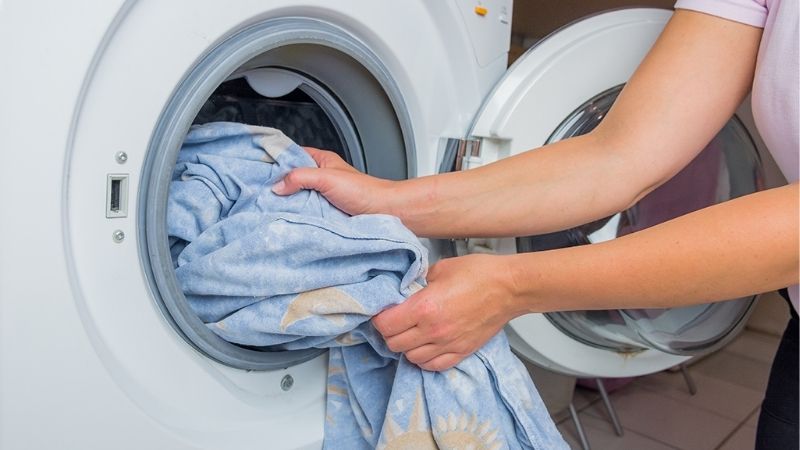
Place the comforter loosely into a suitable washer so it can shift as water circulates. Avoid adding sheets, towels, or other heavy bedding in an attempt to balance the load unless your washer manual explicitly recommends a particular arrangement. A bulky item needs room to saturate, release trapped air, and rinse. This is particularly important for a large down-filled comforter whose internal chambers must retain their shape while wet.
If a machine has a central agitator, follow the maker’s loading instructions rather than winding the comforter tightly around the post. In a front-loading machine, do not let a closed door become your only test of capacity. Stop and use a different appliance when the drum is packed, the comforter cannot turn, or the manual excludes the item. The right washer can make this process simpler; an undersized one can leave the filling wet or strain the stitching and machine.
Step 3: Match Water Temperature and Cycle to the Label
Select the prescribed water temperature first, followed by a cycle suitable for bulky bedding. A bedding or bulky cycle is available on many American home washers, but it may use a different movement pattern from a delicate cycle. Whirlpool and Maytag describe cool or warm water and bulky or gentle programs as common choices for appropriately labeled comforters [Whirlpool; Maytag, accessed October 2026]. Those are useful examples, not permission to ignore a cold-only label or a professional-cleaning instruction.
A heavily filled item does not become cleaner simply because the cycle is hotter or more forceful. Excessive agitation may pull at baffles, while unapproved heat can affect shell finishes or sensitive fill. If your machine offers an extra-rinse option compatible with its bedding program, that can help clear remaining detergent. Keep machine defaults from silently changing an approved wash into an unsuitable high-temperature or high-spin treatment.
Step 4: Add Compatible Detergent and Check the Rinse
Use a modest, label-compatible quantity of mild detergent. Large fabric surfaces are not a reason to pour in extra soap; residue can cling to dense fill and make the shell feel stiff. Whirlpool recommends a mild, fragrance-free detergent for typical machine-washable comforters and advises checking material restrictions before using fabric softener [Whirlpool, accessed October 2026]. If your washer has a detergent dispenser, use it as instructed rather than pouring concentrated liquid directly onto one small patch of fabric.
At the end of the wash, look for unusual foam or slippery patches, which can suggest leftover detergent. A care-approved extra rinse may be appropriate, but avoid repeated full wash cycles as a substitute for a correctly loaded first cycle. Do not add chlorine bleach, oxygen bleach, scent boosters, or softening products just because they work on everyday sheets. The comforter’s own care information should authorize any treatment that could affect its shell, fill, or stitching.
Step 5: Dry with Space, Correct Heat, and Regular Checks
Transfer the wet comforter gently, supporting its weight instead of dragging it by one corner. A spacious dryer can help permitted fills dry more evenly; a crowded drum can trap damp areas. Maytag gives a dryer capacity around 7.0 cubic feet as a general reference for large comforters, but fit still depends on the particular item [Maytag, accessed October 2026]. Use the temperature and dryer method on your label. Low or no heat is often recommended for many washable fills, though it is not a universal rule.
Where allowed by the manufacturer, clean wool dryer balls can encourage movement as the comforter tumbles. Stop periodically to redistribute the fabric and check the thicker corners and stitched compartments. A light surface that feels dry does not prove the interior fill is dry. If the label calls for line drying, spread the weight over appropriate support in a ventilated location instead of suspending wet bedding from a fragile hook. Avoid direct high heat as a shortcut unless the exact care directions permit it.
Step 6: Confirm the Inner Filling Is Completely Dry
Before returning the comforter to the bed, feel several parts of the interior, including seams, corners, and thickest filled sections. Damp clumps, a cool heavy patch, or moisture trapped at a baffle means the process is not finished. Give the permitted dryer or air-drying method more time, turning the comforter when necessary to expose hidden areas. Maytag and Whirlpool both emphasize thorough drying because filled bedding can retain moisture beyond what its outer shell suggests [Maytag; Whirlpool, accessed October 2026].
Only when the filling is fully dry should you redistribute it with a gentle shake, make the bed, or place the comforter in storage. Do not hide slightly damp bedding under sheets or in a tight plastic bag, where moisture can linger. If an insert comes out repeatedly wet in the center despite a properly loaded cycle, reassess your dryer’s available space or move to a larger approved machine. Persistent clumping after full drying calls for checking the fill construction rather than automatically washing it again.
Frequently Asked Questions
Most difficulties appear at the boundaries of a standard laundering routine: removable covers, washer interruptions, chemical additives, and professional-cleaning instructions. The answers below address those exceptions without changing the basic sequence for a machine-washable comforter.
Should You Wash a Duvet Cover While It Is Still on the Comforter?
No. Take off a removable duvet cover and wash the cover according to its own label. The two pieces can have different fibers, wash temperatures, and drying limits. Leaving them attached can also make it harder for detergent and rinse water to reach the comforter’s shell evenly. Corner ties and buttons may twist under the weight of wet bedding.
Check for trapped socks, clips, or other laundry inside the cover before washing. When both pieces have finished drying fully, fasten the cover back onto the insert without pulling its corner loops forcefully. This separation is about cleaning two distinct textile items correctly, not a recommendation to run the filled insert as often as the outer cover.
What If the Washer Stops Because the Comforter Is Unbalanced?
Stop the machine and follow its on-screen instructions or user manual before opening or redistributing a wet load. Do not force the door, bypass a safety lock, or repeatedly restart a spin cycle that keeps failing. A saturated comforter can be too heavy or unevenly distributed for a compact appliance, even when it fit inside while dry.
If the washer’s approved balancing procedure does not resolve the problem, arrange safe removal once the machine permits it and move the item to suitable equipment. Avoid tugging on a wet corner or transferring an unstable, dripping mass without support. The interruption is a reason to reassess the appliance’s suitability, not to select a more forceful wash cycle.
Can You Use Bleach on a White Comforter?
Only if the particular comforter’s care directions allow the specific bleach type. A white shell does not mean its stitching, colored labels, trim, or internal fill can tolerate chlorine bleach. Likewise, a bottle marketed as color-safe does not make an oxygen-based additive automatically compatible with every bedding construction.
When the tag prohibits bleach or does not clearly authorize it, use the detergent and spot-treatment methods that the manufacturer does recommend. If discoloration is severe, ask the maker or a textile-cleaning professional about acceptable options before experimenting. Protecting the fill and shell is more useful than producing a temporarily whiter surface through an unapproved treatment.
Is a Home Dry-Cleaning Kit a Substitute for Professional Cleaning?
No. A home dryer kit is not necessarily the professional solvent-cleaning process specified on a comforter’s label. If the manufacturer directs professional dry cleaning, give the actual item and its care details to a qualified cleaner. Be especially cautious with silk, wool, delicate decorative construction, or bedding whose sewn-in label prohibits immersion.
Ask the cleaner whether they can handle the comforter’s size and particular fill, and clarify any known stains or previous unsuccessful cleaning attempts. Some manufacturers provide alternative approved care routes for specific models, but such permission must come from those directions. A package advertising ‘dry-cleaning results’ is not evidence that it meets your comforter’s requirements.
Final Thoughts
For anyone learning how to wash comforter bedding, the decisive checkpoints are the exact care label, genuine room inside both machines, and a fully dry interior. If any checkpoint fails, use an approved commercial or professional service rather than risking damaged fill. Separate the removable cover, and keep the cleaning process specific to the comforter you actually own.